Our first meeting was a bit awkward. One of us is an archaeologist who studies how past peoples interacted with their environments. Two of us are geophysicists who investigate interactions between solar activity and Earth’s magnetic field.
When we first got together, we wondered whether our unconventional project, linking space weather and human behavior, could actually bridge such a vast disciplinary divide. Now, two years on, we believe the payoffs – personal, professional and scientific – were well worth the initial discomfort.
Our collaboration, which culminated in a recent paper in the journal Science Advances, began with a single question: What happened to life on Earth when the planet’s magnetic field nearly collapsed roughly 41,000 years ago?
Weirdness when Earth’s magnetic shield falters
This near-collapse is known as the Laschamps Excursion, a brief but extreme geomagnetic event named for the volcanic fields in France where it was first identified. At the time of the Laschamps Excursion, near the end of the Pleistocene epoch, Earth’s magnetic poles didn’t reverse as they do every few hundred thousand years. Instead, they wandered, erratically and rapidly, over thousands of miles. At the same time, the strength of the magnetic field dropped to less than 10% of its modern day intensity.
So, instead of behaving like a stable bar magnet – a dipole – as it usually does, the Earth’s magnetic field fractured into multiple weak poles across the planet. As a result, the protective force field scientists call the magnetosphere became distorted and leaky.
The magnetosphere normally deflects much of the solar wind and harmful ultraviolet radiation that would otherwise reach Earth’s surface.
So, during the Laschamps Excursion when the magnetosphere broke down, our models suggest a number of near-Earth effects. While there is still work to be done to precisely characterize these effects, we do know they included auroras – normally seen only in skies near the poles as the Northern Lights or Southern Lights – wandering toward the equator, and significantly higher-than-present-day doses of harmful solar radiation.
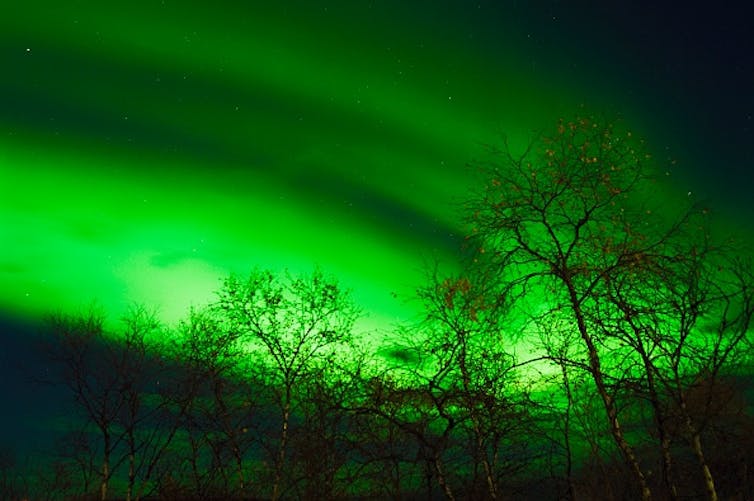
Aurors in the skies above Europe could have been breathtaking, terrifying or both for ancient humans.
The skies 41,000 years ago may have been both spectacular and threatening. When we realized this, we two geophysicists wanted to know whether this could have affected people living at the time.

The archaeologist’s answer was absolutely.
Human responses to ancient space weather
For people on the ground at that time, auroras may have been the most immediate and striking effect, perhaps inspiring awe, fear, ritual behavior or something else entirely. But the archaeological record is notoriously limited in its ability to capture these kinds of cognitive or emotional responses.
Researchers are on firmer ground when it comes to the physiological impacts of…