
Curious Kids is a series for children of all ages. If you have a question you’d like an expert to answer, send it to [email protected].
Why is heart cancer so rare? – Jackson, age 12, Davis, California
You probably know someone who is affected by cancer. This disease results when cells divide uncontrollably and can make a person sick, sometimes very seriously.
Cancer can occur anywhere in the body because every tissue and organ is made up of billions or even trillions of cells. But there are some parts of the body where cancer doesn’t happen as often, such as the heart. Studies show 3 in 10,000 people develop heart cancer. In comparison, 1 in 20 women are expected to develop breast cancer. Why is that?
I’m a biologist who specializes in the blood vessels of the cardiovascular system. A big part of my work focuses on how cells interact with their environment to regulate the function of tissues and organs. Disease can develop when things go wrong.
Turns out, heart cells have unique features that make them super resistant to cancer.
How cancer starts
Cells produce more cells to grow, replace older or worn-out cells or to repair damaged tissues. This process is called cell division. Each type of cell in the body divides at different rates based on multiple factors, including what their function is and a person’s age.
For example, the cells of a growing human embryo divide extremely fast, undergoing four divisions in three days. The cells that make up the skin, nails and hair regularly replenish across your lifespan. Bone cells divide at a rate that will give you an entirely new skeleton approximately every 10 years.
Whether and how often a cell divides is tightly regulated by a series of molecular checkpoints. During cell division, genes within DNA are duplicated and evenly distributed into two daughter cells. Damage to these genes caused by exposure to harmful chemicals, ultraviolet light or radiation can result in mutations that cause disease. Mutations can just happen randomly, too. When there are mutations on the genes regulating cell division, cancer can develop.
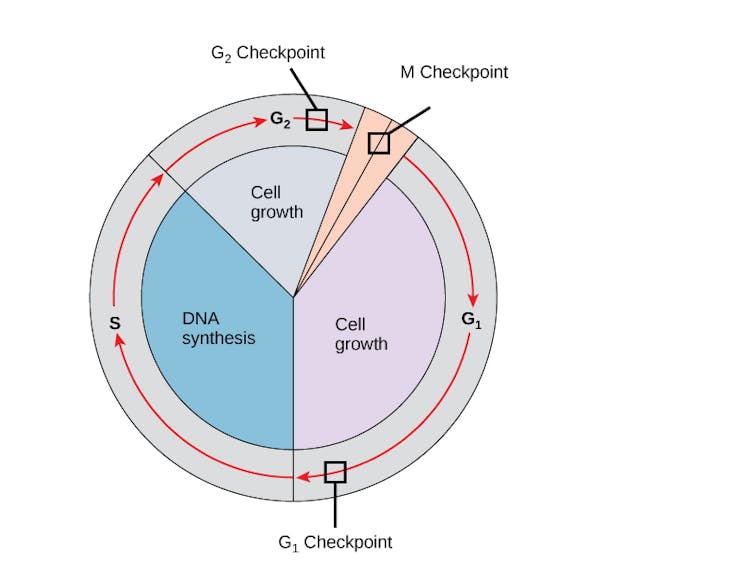
Cells move through a series of checkpoints before division.
OpenStax, CC BY-SA
What protects heart cells from cancer?
Even though the heart is the first organ to form and start working during early development, cells in the adult heart divide very few times after birth, with division dramatically declining after age 20. In fact, less than 50% of heart cells are replaced over the course of an average human life. That means half of the heart cells you’re born with will be helping pump blood for your entire life.
This low rate of cell division in the adult heart likely serves as its primary defense against cancer. The less often a cell divides, the fewer opportunities there are for mistakes during DNA replication.