The soil in high-elevation, cooler, drier tropical forests in the Colombian Andes stores more carbon from fires than lower, warmer regions, new research shows.
Scientists investigated the long-term impact of fire on Andean forest soils, finding that carbon from fires—known as pyrogenic carbon (PyC)—varies greatly across Colombia’s lowlands and Andean mountains.
They analyzed soil samples from 36 plots across different elevations and land-use types, including lowland, mid-elevation, and High Andean forests.
They found that—while overall soil organic carbon (SOC) is substantial in Andean forests—High Andean forests had PyC stocks nine to ten times higher than those in the warmer, low Andean forests and the Amazon Basin rainforest.
The study was led by Dr. Carmen R. Montes-Pulido from Universidad Nacional Abierta y a Distancia, Professor Ted Feldpausch from the University of Exeter, and colleagues from James Cook University and Instituto Nacional de Pesquisas da Amazônia. The findings are published in the journal Global Change Biology.
Professor Feldpausch said, “Our study highlights the long-term legacy effects of wildfires on Andean forest soils. These are the first data of this type for the northern Andes and the substantially larger fire-derived soil carbon found in the high Andean forests represents an important persistent carbon reservoir. The results raise questions about how historical land-use over hundreds to thousands of years may have interacted with variation in climate and fire regimes to alter fire-derived soil carbon.”
The research found that mean annual precipitation, soil clay content, and pH were the primary environmental factors related to soil PyC storage. These factors influence the formation and preservation of PyC in the soil, highlighting the interaction between climate, soil chemistry, and fire history in shaping carbon stocks.
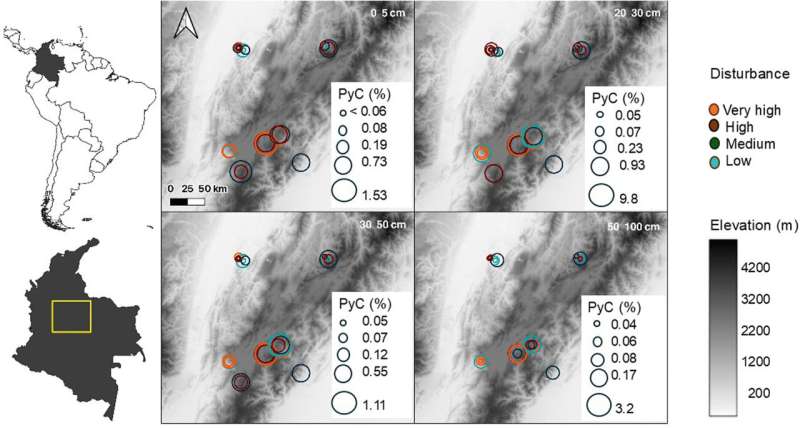
Spatial distribution of PyC (%) soil samples at 0–5, 20–30, 30–50, and 50–100 cm in 36 plots of 0.5-ha Colombian Andes forest and agrosilvopastoral systems. Circles are scaled to the amount of PyC in percentage and grey shades indicate the altitudinal gradient. Disturbance gradient in the study area: Low (blue), medium (dark green), high (brown), very high (orange). The very high disturbance corresponds to agrosilvopastoral plots. Map lines delineate study areas and do not necessarily depict accepted national boundaries. © Global Change Biology (2025). DOI: 10.1111/gcb.70135
Dr. Carmen R. Montes-Pulido said, “The findings highlight the larger-than-expected contribution of PyC to the total carbon pool in Andean forest soils and its importance as a stable and persistent form of carbon, particularly under projected global warming scenarios.”
These research findings are essential for improving our understanding of carbon cycling in tropical mountain ecosystems and refining global carbon models, since PyC is much slower to decompose—over hundreds to thousands of years—than other forms of soil carbon.
The study shows that PyC in Andean forest soils, especially at cooler, drier high elevations, is not only a significant carbon reservoir but also a key component in the long-term carbon storage capacity of these biodiverse, vulnerable ecosystems.
As climate change increases temperatures, understanding the dynamics of PyC in these elevation gradients becomes increasingly important for conservation and climate mitigation strategies.
More information:
Carmen R. Montes‐Pulido et al, Climatic and Edaphic Drivers of Soil Organic Carbon and Pyrogenic Carbon Stocks Across Elevation and Disturbance Gradients in Colombian Andean Forests, Global Change Biology (2025). DOI: 10.1111/gcb.70135
Provided by
University of Exeter
Citation:
High-elevation tropical forest soils in Colombian Andes found rich in carbon from past fires (2025, July 25)