The first space race was about flags and footprints. Now, decades later, landing on the Moon is old news. The new race is to build there, and doing so hinges on power.
In April 2025, China reportedly unveiled plans to build a nuclear power plant on the Moon by 2035. This plant would support its planned international lunar research station.
The United States countered in August, when acting NASA Administrator Sean Duffy reportedly suggested a U.S. reactor would be operational on the Moon by 2030.
While it might feel like a sudden sprint, this isn’t exactly breaking news. NASA and the Department of Energy have spent years quietly developing small nuclear power systems to power lunar bases, mining operations and long-term habitats.
As a space lawyer focused on long-term human advancement into space, I see this not as an arms race but as a strategic infrastructure race. And in this case, infrastructure is influence.
A lunar nuclear reactor may sound dramatic, but its neither illegal nor unprecedented. If deployed responsibly, it could allow countries to peacefully explore the Moon, fuel their economic growth and test out technologies for deeper space missions. But building a reactor also raises critical questions about access and power.
The legal framework already exists
Nuclear power in space isn’t a new idea. Since the 1960s, the U.S. and the Soviet Union have relied on radioisotope generators that use small amounts of radioactive elements – a type of nuclear fuel – to power satellites, Mars rovers and the Voyager probes.
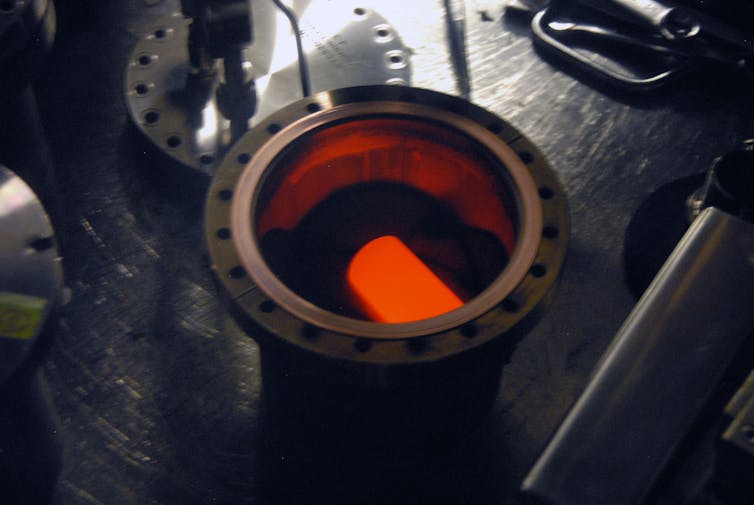
Nuclear energy in space isn’t new – some spacecraft are nuclear-powered. This photo shows the nuclear heat source for the Mars Curiosity rover encased in a graphite shell. The fuel glows red hot because of the radioactive decay of plutonium-238.
Idaho National Laboratory, CC BY
The United Nations’ 1992 Principles Relevant to the Use of Nuclear Power Sources in Outer Space, a nonbinding resolution, recognizes that nuclear energy may be essential for missions where solar power is insufficient. This resolution sets guidelines for safety, transparency and international consultation.

Nothing in international law prohibits the peaceful use of nuclear power on the Moon. But what matters is how countries deploy it. And the first country to succeed could shape the norms for expectations, behaviors and legal interpretations related to lunar presence and influence.
Why being first matters
The 1967 Outer Space Treaty, ratified by all major spacefaring nations including the U.S., China and Russia, governs space activity. Its Article IX requires that states act with “due regard to the corresponding interests of all other States Parties.”
That statement means if one country places a nuclear reactor on the Moon, others must navigate around it, legally and physically. In effect, it draws a line on the lunar map. If the reactor anchors a larger, long-term facility,…