
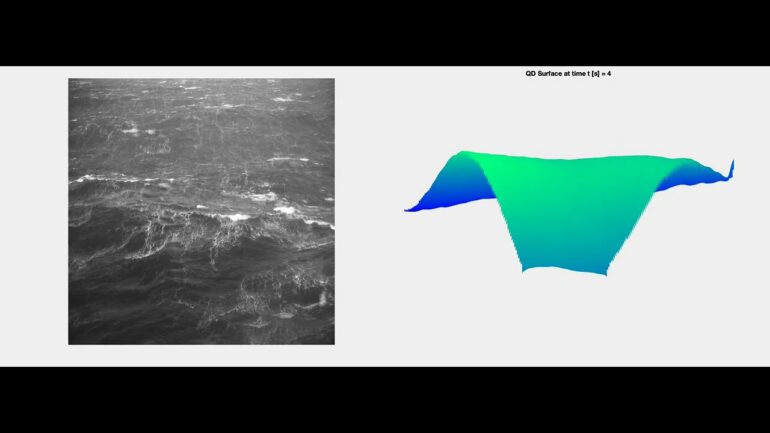
Rogue waves have captivated the attention of both seafarers and scientists for decades. These are giant, isolated waves that appear suddenly in the open ocean.
These puzzling giants are brief, typically lasting less than a minute before disappearing. They can reach heights of 65 feet (20 meters) or greater and often more than twice the height of surrounding waves. Once a nautical myth, rogue waves have now been observed around the world. Because they’re so tall and powerful, they can pose a danger to ships and offshore structures.
To rethink what rogue waves are and what causes them, I gathered an international team of researchers. Our study, published in Nature Scientific Reports, sheds light on these oceanic giants using the most comprehensive dataset of its kind.
By analyzing 18 years of high-frequency laser measurements from the Ekofisk oil platform in the central North Sea, we reached the surprising conclusion that rogue waves aren’t just freak occurrences. They arise under the natural laws of the sea. They are not mysterious, but somewhat simple.
27,500 sea states
We analyzed nearly 27,500 half-hour wave records, or sea states, collected between 2003 and 2020 in the central North Sea. These records, taken every 30 minutes, describe how elevated the sea surface was compared to the average sea level. They include major storms, such as the Andrea wave event in 2007.
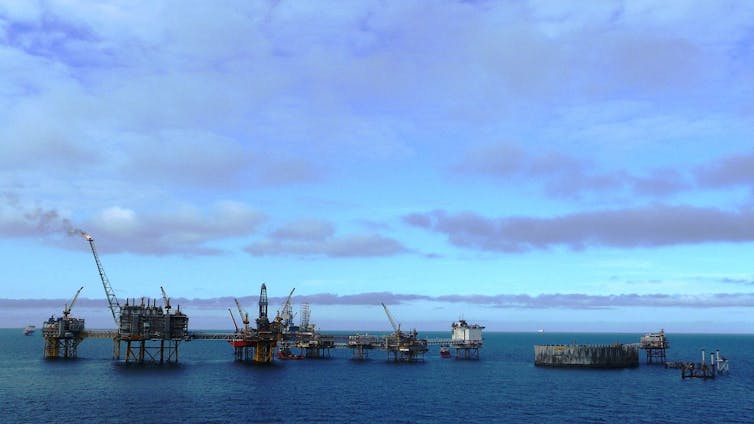
A complex of platforms on the Ekofisk oil field in the North Sea.
BoH/Wikimedia Commons, CC BY-SA
Under normal conditions, waves arise from wind blowing over the sea surface. It’s like when you blow over your cup of coffee and form small ripples on the surface. At sea, with enough time and space, those ripples can turn into large waves.
We focused on understanding what causes waves to suddenly go rogue and rise far above their neighboring waves. One proposed theory is based on modulational instability, a phenomenon described by complex mathematical models. I’ve revised these models in the past, as my work suggests that this theory doesn’t fully explain what causes rogue waves in the open ocean.

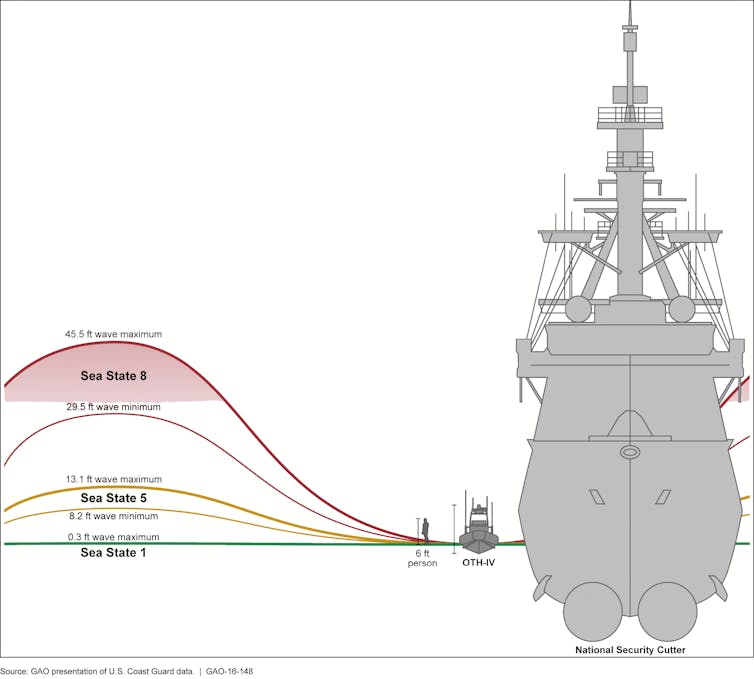
Sea states record the height of waves and show when some waves rise high above sea level.
U.S. Government Accountability Office
When waves are trapped within a narrow channel, the modulational instability theory describes their rippling movement well. However, it starts to fall apart when you look at the real ocean. In open environments such as the North Sea, waves are free to propagate from multiple directions.
To understand the difference, imagine a crowd of spectators leaving a stadium after a football game. If the exit is a long, narrow hallway with tall walls, people are forced to move in a single direction. Those at the back push forward, and some may even climb over others, piling up between the confining walls. This catastrophic pileup would resemble a rogue wave, caused by…

