
Insects are becoming increasingly popular to grow on farms as feed for other animals, pet food and potentially as food for people. The process of bringing a wild animal into an artificial environment, known as domestication, comes with unique challenges. Luckily, there are important lessons to be learned from all the other animals people have domesticated over millennia.
As researchers who study how domesticating animals changes their genes, we believe that recognizing the vulnerabilities that come with domestication is important. Today’s powerful biotechnology tools can help researchers anticipate and head off issues early on.
Domestication is nothing new
From grain domestication starting as far back as 12,000 years ago to today’s high-tech, genome-based breeding strategies, humans have long bent nature to suit their purposes. By selectively breeding individual plants or animals that have desirable traits – be it appearance, size or behavior – humans have domesticated a whole host of species.
The same principle underlies all domestication attempts, from dogs to crops. A breeder identifies an individual with a desired trait – whether that’s a dog’s talent for tracking or a plant’s ability to withstand pests. Then they breed it to confirm that the desired trait can be passed down to offspring. If it works, the breeder can grow lots of descendants in a lineage with the genomic advantage.
People have made crops resilient to disease and environmental challenges, docile cows that yield more milk or meat, large-breasted poultry and cute dogs.
A long history of insects working for people
Insect domestication is also far from new. People have reared silkworms (Bombyx mori) to produce silk for over 5,000 years. But selective breeding and isolation from wild relatives have led to their inability to fly, dependence on one food source and need for assistance to reproduce. As a result, silkworms are wholly reliant on humans for survival, and the original species doesn’t exist anymore.
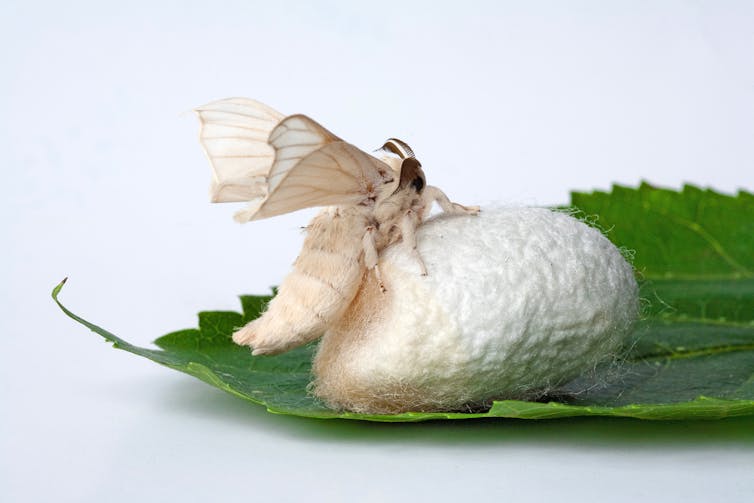
Silk moths have lost their ability to fly and are completely dependent on humans for survival.
baobao ou/Moment Open via Getty Images
Similarly, people have maintained colonies of the western honeybee (Apis mellifera) for pollination and honey production for centuries. But bees are at risk due to colony collapse disorder, a phenomenon where worker bees disappear from seemingly healthy hives. The causes of colony collapse disorder are unknown; researchers are investigating disease and pesticides as possible factors.

Now the insect agriculture industry has set its sights on domesticating some other insects as a source of sustainably farmed protein for other animals or people.
Insects such as the black soldier fly (Hermetia illucens) and the mealworm (Tenebrio molitor) can grow on existing organic waste streams. Rearing them on organic farm and food waste circularizes the agricultural system and reduces…

