
Artificial intelligence is growing fast, and so are the number of computers that power it. Behind the scenes, this rapid growth is putting a huge strain on the data centers that run AI models. These facilities are using more energy than ever.
AI models are getting larger and more complex. Today’s most advanced systems have billions of parameters, the numerical values derived from training data, and run across thousands of computer chips. To keep up, companies have responded by adding more hardware, more chips, more memory and more powerful networks. This brute force approach has helped AI make big leaps, but it’s also created a new challenge: Data centers are becoming energy-hungry giants.
Some tech companies are responding by looking to power data centers on their own with fossil fuel and nuclear power plants. AI energy demand has also spurred efforts to make more efficient computer chips.
I’m a computer engineer and a professor at Georgia Tech who specializes in high-performance computing. I see another path to curbing AI’s energy appetite: Make data centers more resource aware and efficient.
Energy and heat
Modern AI data centers can use as much electricity as a small city. And it’s not just the computing that eats up power. Memory and cooling systems are major contributors, too. As AI models grow, they need more storage and faster access to data, which generates more heat. Also, as the chips become more powerful, removing heat becomes a central challenge.
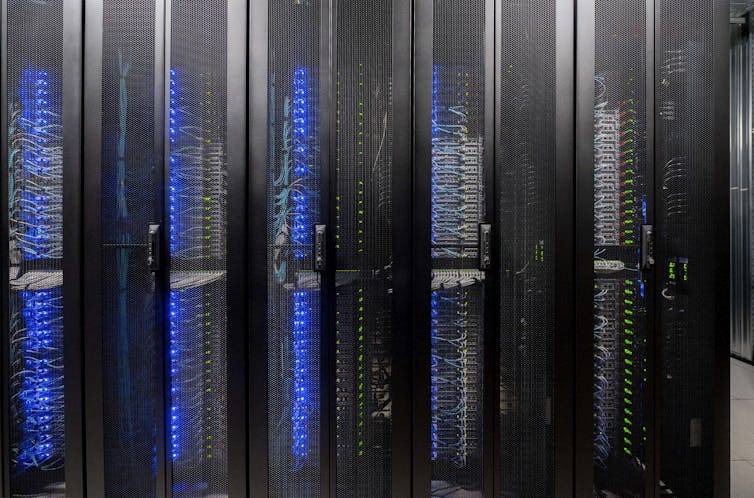
Data centers house thousands of interconnected computers.
Alberto Ortega/Europa Press via Getty Images
Cooling isn’t just a technical detail; it’s a major part of the energy bill. Traditional cooling is done with specialized air conditioning systems that remove heat from server racks. New methods like liquid cooling are helping, but they also require careful planning and water management. Without smarter solutions, the energy requirements and costs of AI could become unsustainable.
Even with all this advanced equipment, many data centers aren’t running efficiently. That’s because different parts of the system don’t always talk to each other. For example, scheduling software might not know that a chip is overheating or that a network connection is clogged. As a result, some servers sit idle while others struggle to keep up. This lack of coordination can lead to wasted energy and underused resources.

A smarter way forward
Addressing this challenge requires rethinking how to design and manage the systems that support AI. That means moving away from brute-force scaling and toward smarter, more specialized infrastructure.
Here are three key ideas:
Address variability in hardware. Not all chips are the same. Even within the same generation, chips vary in how fast they operate and how much heat they can tolerate, leading to heterogeneity in both performance and energy efficiency. Computer systems in data centers…