
In “The Singularity is Nearer: When We Merge with AI,” the futurist Ray Kurzweil imagines the point in 2045 when rapid technological progress crosses a threshold as humans merge with machines, an event he calls “the singularity.”
Although Kurzweil’s predictions may sound more like science fiction than fact-based forecasting, his brand of thinking goes well beyond the usual sci-fi crowd. It has provided inspiration for American technology industry elites for some time, chief among them Elon Musk.
With Neuralink, his company that is developing computer interfaces implanted in people’s brains, Musk says he intends to “unlock new dimensions of human potential.” This fusion of human and machine echoes Kurzweil’s singularity. Musk also cites apocalyptic scenarios and points to transformative technologies that can save humanity.
Ideas like those of Kurzweil and Musk, among others, can seem as if they are charting paths into a brave new world. But as a humanities scholar who studies utopianism and dystopianism, I’ve encountered this type of thinking in the futurist and techno-utopian art and writings of the early 20th century.
Techno-utopianism’s origins
Techno-utopianism emerged in its modern form in the 1800s, when the Industrial Revolution ushered in a set of popular ideas that combined technological progress with social reform or transformation.
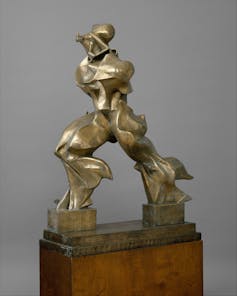
Umberto Boccioni’s 1913 sculpture ‘Unique Forms of Continuity in Space’ conveys speed, dynamism and the melding of human and machine.
Sepia Times/Universal Images Group via Getty Images
Kurzweil’s singularity parallels ideas from Italian and Russian futurists amid the electrical and mechanical revolutions that took place at the turn of the 20th century. Enthralled by inventions like the telephone, automobile, airplane and rocket, those futurists found inspiration in the concept of a “New Human,” a being who they imagined would be transformed by speed, power and energy.
A century ahead of Musk, Italian futurists imagined the destruction of one world, so that it might be replaced by a new one, reflecting a common Western techno-utopian belief in a coming apocalypse that would be followed by the rebirth of a changed society.

One especially influential figure of the time was Filippo Marinetti, whose 1909 “Founding and Manifesto of Futurism” offered a nationalistic vision of a modern, urban Italy. It glorified the tumultuous transformation caused by the Industrial Revolution. The document describes workers becoming one with their fiery machines. It encourages “aggressive action” coupled with an “eternal” speed designed to break things and bring about a new world order.
The overtly patriarchal text glorifies war as “hygiene” and promotes “scorn for woman.” The manifesto also calls for the destruction of museums, libraries and universities and supports the power of the rioting crowd.
Marinetti’s…

