Scientists first detected ripples in space known as gravitational waves from the merger of two black holes in September 2015. This discovery marked the culmination of a 100-year quest to prove one of Einstein’s predictions.
Two years after this watershed moment in physics came a second late-summer breakthrough in August 2017: the first detection of gravitational waves accompanied by electromagnetic waves from the merger of two neutron stars.
Gravitational waves are exciting to scientists because they provide a completely new view of the universe. Conventional astronomy relies on electromagnetic waves – like light – but gravitational waves are an independent messenger that can emanate from objects that don’t emit light. Gravitational wave detection has unlocked the universe’s dark side, giving scientists access to phenomena never observed before.
As a gravitational wave physicist with over 20 years of research experience in the LIGO Scientific Collaboration, I have seen firsthand how these discoveries have transformed scientists’ knowledge of the universe.
This summer, in 2025, scientists with the LIGO, Virgo and KAGRA collaboration also marked a new milestone. After a long hiatus to upgrade its equipment, this collaboration just released an updated list of gravitational wave discoveries. The discoveries on this list provide researchers with an unprecedented view of the universe featuring, among other things, the clearest gravitational wave detection yet.
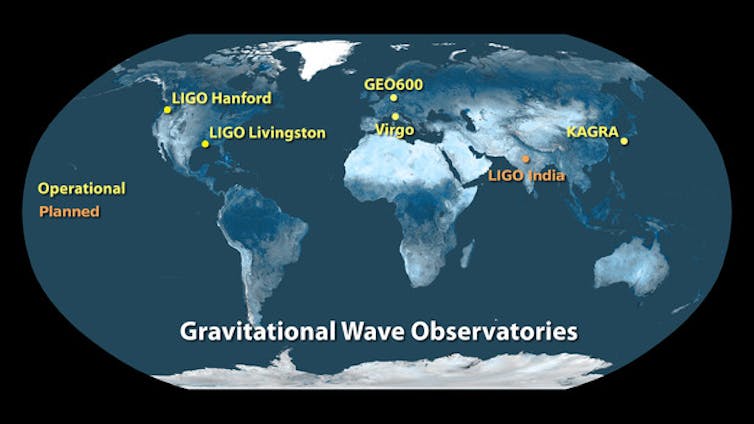
The more operational gravitational-wave observatories there are around the globe, the easier it is to pin down the locations and sources of gravitational waves coming from space.
Caltech/MIT/LIGO Lab
What are gravitational waves?
Albert Einstein first predicted the existence of gravitational waves in 1916. According to Einstein’s theory of gravity, known as general relativity, massive, dense celestial objects bend space and time.
When these massive objects, like black holes and neutron stars – the end product of a supernova – orbit around each other, they form a binary system. The motion from this system dynamically stretches and squeezes the space around these objects, sending gravitational waves across the universe. These waves ever so slightly change the distance between other objects in the universe as they pass.
Detecting gravitational waves requires measuring distances very carefully. The LIGO, Virgo and KAGRA collaboration operates four gravitational wave observatories: two LIGO observatories in the U.S., the Virgo observatory in Italy and the KAGRA observatory in Japan.
Each detector has L-shaped arms that span over two miles. Each arm contains a cavity full of reflected laser light that precisely measures the distance between two mirrors.
As a gravitational wave passes, it changes the distance between the mirrors by 10-18 meters — just 0.1% of the diameter of a proton. Astronomers can measure how the…