As the Perseverance rover traversed an ancient river valley in Mars’ Jezero Crater back in July 2024, it drilled into the surface and extracted a sample from of a unique, striped rock called Chevaya Falls. The rover’s instruments then analyzed the sample, which is called Sapphire Canyon, and surveyed the surrounding rock.
When scientists started looking into the data, they found two types of iron-rich minerals arranged on the rock in a distinctive, spotted pattern. Both these minerals are associated with life on Earth. One is found around decomposing organic matter on Earth, while the other is produced by certain microbes.
A team of researchers determined in a study published Sept. 10, 2025, that the sample contains a potential biosignature – which could suggest the red planet once hosted microbial life.
These minerals may have formed on the rock when ancient microbes used chemical reactions to produce energy. But chemical reactions not related to life can also produce these minerals under certain conditions.
To learn more, The Conversation U.S. asked Amy J. Williams, an astrobiologist at the University of Florida, about biosignature hunting on Mars and what’s so special about this Sapphire Canyon sample.
What are biosignatures?
A biosignature is any characteristic, element, molecule, substance or feature that serves as evidence for past or present life. It must be something that cannot be produced without life. Some examples include fossils, organic molecules derived from a biological process, or mineral patterns that form only through microbial activity.
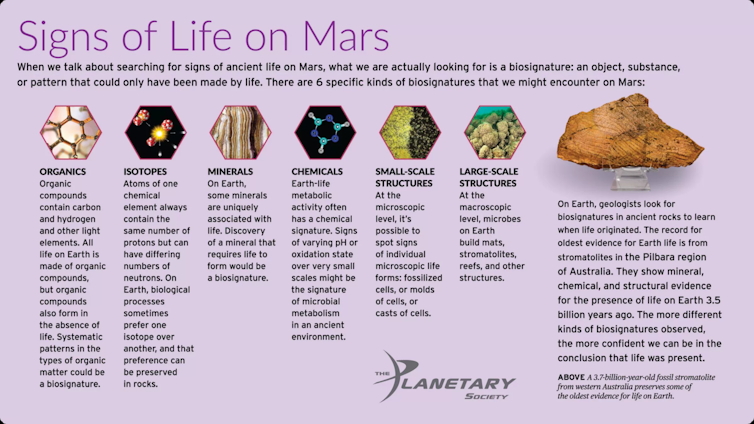
There are six types of biosignatures that scientists may find on Mars.
The Planetary Society, CC BY
A potential biosignature, which is how the Sapphire Canyon finding is described, is a substance or structure that might have a biological origin but requires more data or further study before scientists can make a conclusion about the absence or presence of life.
How do scientists determine whether something could be a biosignature on Mars?
Biosignatures come in many different flavors – chemical, physical or structural. Some are rather obvious, like a dinosaur fossil on Earth, but most are far more nuanced.

The search for ancient life on Earth partially informs the search for biosignatures on Mars. Researchers rely on subtle clues preserved in the rock record to address questions such as how long ago microbial life arose on Earth. We search for that evidence in environments such as craters and lake beds with high preservation potential, meaning those that are likely to preserve the biosignatures.
Scientists can apply these techniques to the search for life on Mars. That is why Perseverance was sent to Jezero Crater. In the ancient past, the crater hosted a river-fed lake, which on Earth would represent a habitable environment: one where life would want to live if it ever arose.
This crater was an ideal location to search…