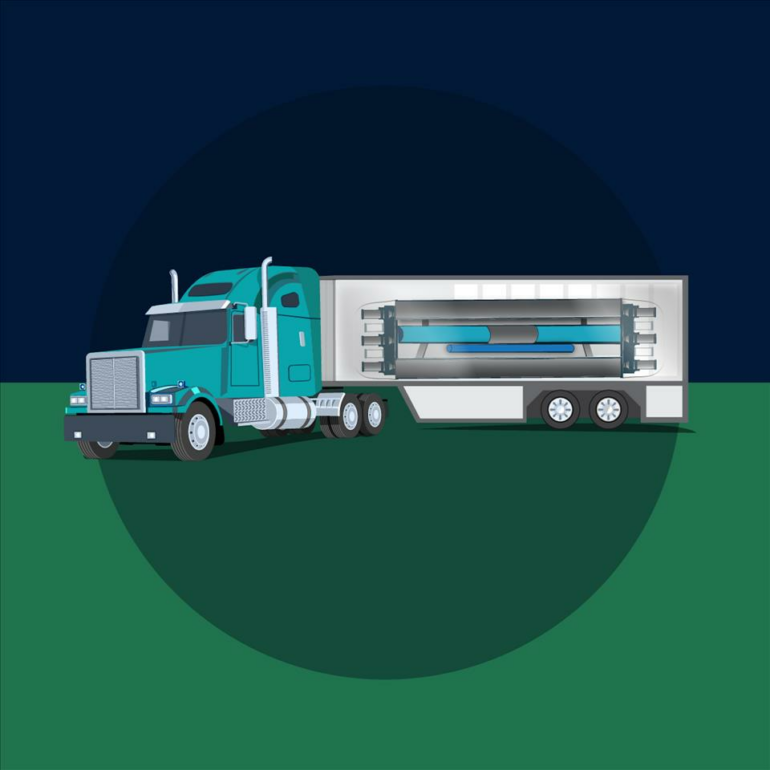
You might imagine nuclear power plants as behemoth facilities spanning hundreds of acres. Nuclear microreactors, by contrast, could sit on land the size of a football field and power a whole town.
However, after decades of fraught relationships between the nuclear industry and communities in many parts of the U.S., building these tiny reactors requires reckoning with the complex history of nuclear technology and rebuilding public trust.
Microreactor technology for use in towns or cities hasn’t been developed yet, but many researchers have been building the case for its use.
For example, this technology could benefit college campuses, remote communities in Alaska primarily powered by oil and diesel, tech companies looking for reliable electricity for AI data centers, companies in need of high-temperature heat for manufacturing and industrial processes, mining operations that need a clean energy source and even military bases in search of a secure source of energy.
I’m a nuclear engineer who has been exploring nuclear microreactors’ potential. My research and teaching focuses on some of the questions that would come with placing miniature nuclear reactors close to where people live.
Microreactors: A history
Nuclear microreactors as a technology are both new and old. In the 1940s and ’50s, the American military and government began developing small reactors and nuclear batteries to power submarines and spacecraft.
After developing these small-scale reactors and batteries for various missions, the nuclear industry’s focus shifted to power reactors. They began to rapidly scale up their designs from producing tens of megawatts to the gigawatt-scale systems common around the world today.
These historical reactors were small because scientists were still learning about the physics and engineering underlying these systems. Today, engineers are deliberately designing microreactors to be small.
Microreactors aren’t to be confused with small modular reactors – these are often scaled-down, modularized versions of large reactors. Small, modular reactors can be built as single units or in clusters to achieve the same capacity as a full-size reactor. Microreactors would be smaller than these, with a power capacity under 20 megawatts.
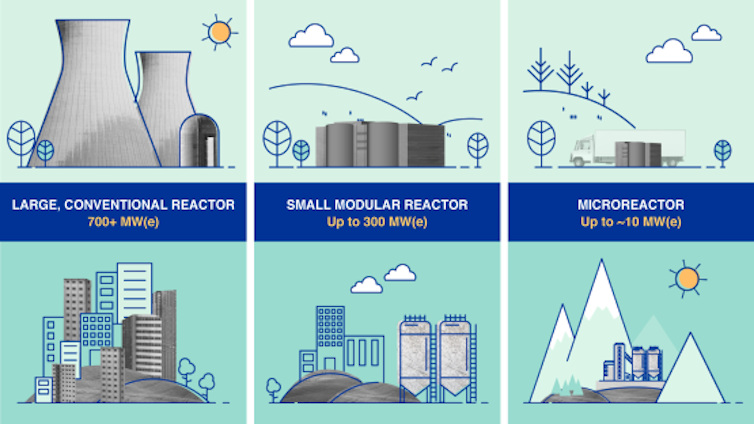

Microreactors are the smallest type of reactor.
A. Vargas/IAEA
Manufacturing and cost
Because they’re small, microreactors wouldn’t require a massive, multiyear construction project like large nuclear power reactors. Several units could be assembled in a factory each year and shipped off to their final destinations in a truck or on a barge.
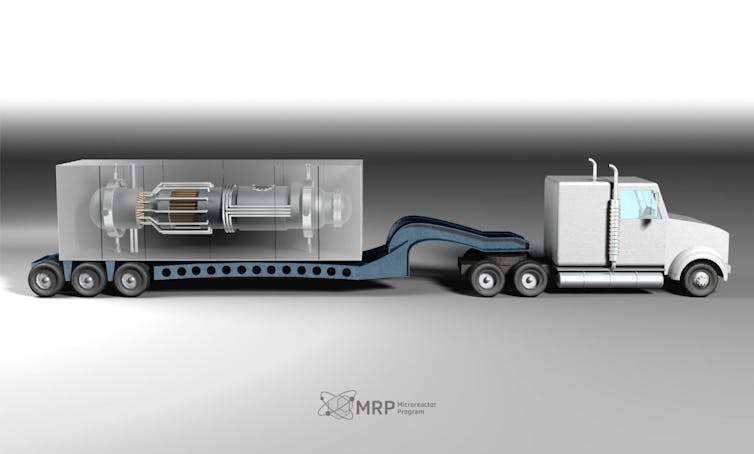
Microreactors could be small enough to fit in the trailer of a truck.
Idaho National Laboratory
Large reactors are not inherently flawed – in many ways, they remain the more economic nuclear energy option. However, electric utility companies have recently hesitated to…