
Curious Kids is a series for children of all ages. If you have a question you’d like an expert to answer, send it to [email protected].
Why can’t we feel the Earth moving? – Dave H., age 12, Atlanta
Right now, you’re zooming through space at incredible speeds. As just one of all the living creatures on Earth, you’re along for the ride as our planet constantly moves in two major ways.
First, consider that the Earth spins around like a top. It’s rotating around the imaginary line that runs from the North Pole to the South Pole through the center of our planet. Earth completes one full rotation every 24 hours, with a speed of about 1,000 miles per hour at the equator (1,670 km/h).
Earth spins on its axis, taking one day to make a full rotation.
While Earth is spinning on its axis, it’s also traveling around the Sun. It takes a year to finish the journey – that is, to make one full revolution and wind up back where we started. Earth hurtles along its path with a whopping average speed of 67,000 miles per hour (107,000 kmh).
These speeds are way faster than any vehicle you’ve ever traveled in. So why aren’t you dizzy or flying off into space? Why don’t you even feel the Earth moving?
It’s this kind of question that lit a desire in me as a child to understand the universe and our place in it. Now I have a Ph.D. in astronomy and teach college students some of the same physics principles that explain why you can’t feel Earth’s motion as it zips through space.
No jerks or bumps
Think about a time when you do feel motion, such as on a carousel ride at an amusement park. When it speeds up, slows down or turns quickly, your body notices because the motion isn’t smooth.

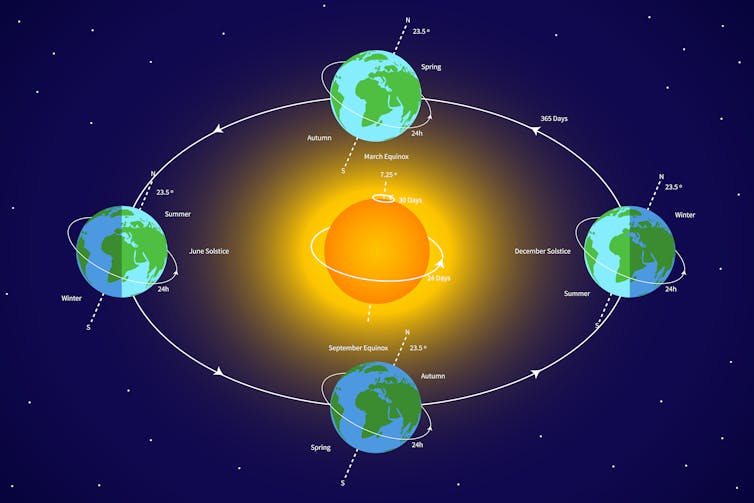
The Earth revolves in an oval-shaped orbit around the Sun while spinning on its slightly tilted axis.
Angela Cini/iStock via Getty Images Plus
In contrast, the Earth’s motion is remarkably steady. It has been spinning on its axis and orbiting the Sun at nearly the same speeds for billions of years, with no sudden jolts or stops. As Earth travels its slightly oval-shaped path around the Sun, its speed does change to be a bit faster when it’s closer to the Sun and a bit slower when it’s farther away. But the changes happen so gradually and smoothly that you don’t feel them at all.
Imagine you’re flying on an airplane that has reached cruising altitude. The engines are humming, you’re soaring through the sky at hundreds of miles per hour – but everything inside feels calm and still. You can walk around, relax and forget you’re traveling at all. That’s because the plane, you and everything else inside it are moving at the same speed, in the same direction.
Just as passengers don’t feel the plane’s speed while smoothly cruising, we don’t feel Earth’s movement…