

Until Homo floresiensis was discovered, scientists assumed that the evolution of the human lineage was defined by bigger and bigger brains. Via a process called encephalization, human brains evolved to be relatively more massive than would be expected based on corresponding body size.
This proportionally bigger brain is what anthropologists argued enabled us and our relatives to perform more complex tasks such as using fire, forging and wielding tools, making art and domesticating animals.
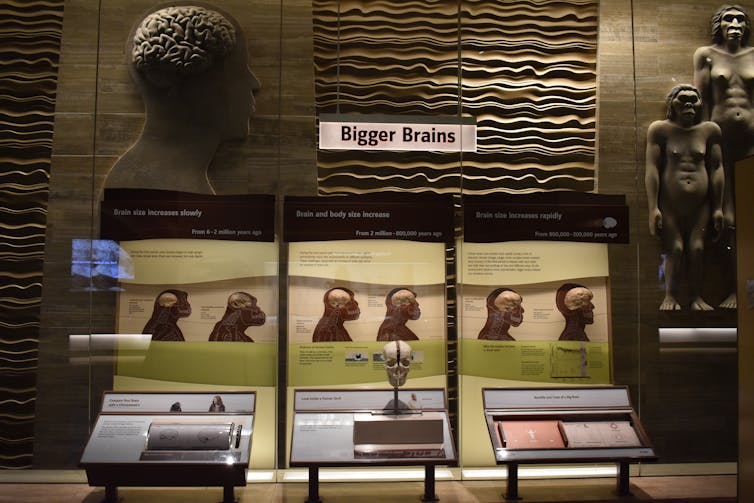
Exhibit on brain size at the Smithsonian’s National Museum of Natural History in Washington, D.C.
Tesla Monson
But these theories had to be thrown out the window when archaeologists announced our fossil cousins Homo floresiensis via scientific publication in 2004. Homo floresiensis lived from about 700,000 to 60,000 years ago in the rainforests of Indonesia, partially contemporaneous with our own species.
Aptly nicknamed Hobbits, Homo floresiensis were short-statured, at just over 3 feet (1 meter) tall, and had a chimp-size brain. This discovery upended the assumption that brains have been increasing in size over the past several million years and generated confusion about what separates recent human relatives in our genus Homo from our more ancient ancestors.
Our new research on the skulls and teeth provides a novel theory for how the Hobbits evolved to be small.
We are professors of anthropology at Western Washington University. After attending a 2023 workshop for biological anthropologists studying juveniles in the fossil record, we began looking at brain size changes across human evolution.
Our previous work on the proportions of molar teeth generated new insights into the evolution of pregnancy by demonstrating that fetal growth rates are tightly linked to molar proportions in primates. Now, we wanted to see whether we could uncover a relationship between tooth proportions and brain size among our fossil relatives.
Paleontologists have only limited skeletal materials, sometimes only a few teeth, for many fossil species, including Homo floresiensis. If tooth proportions can provide information about fossil brain size, it opens up a world of possibilities for assessing past changes in encephalization.

Reconstructing brain size using teeth
We collated data on tooth and brain size for 15 fossil species on the human family tree, spanning about 5 million years of evolution. Somewhat oxymoronically, the third molars – otherwise known as wisdom teeth – have gotten proportionally smaller as brain size has gotten larger throughout human evolution, for most species.
Overall, human relatives with relatively larger wisdom teeth are more ancient and had smaller brains. More recent taxa, like Homo neanderthalensis, had relatively smaller third molars, compared to their other teeth, and larger brains.
This relationship allows researchers to figure out something about brain size for fossils that are…