
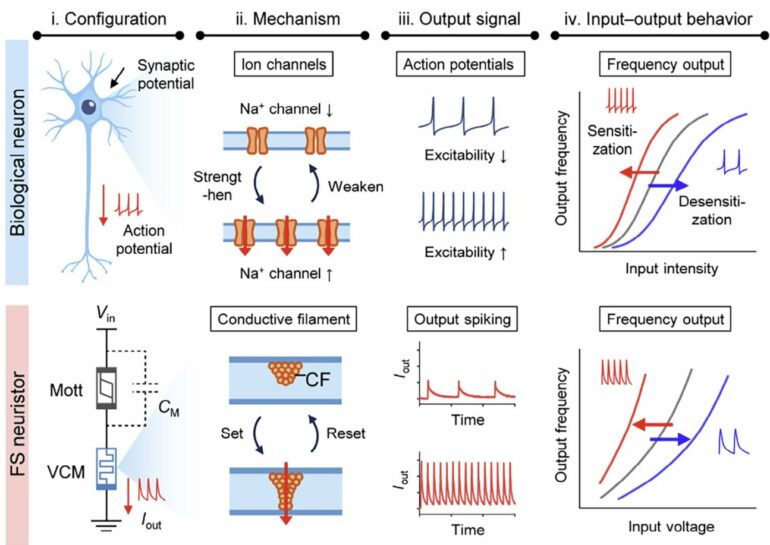
The human brain does more than simply regulate synapses that exchange signals; individual neurons also process information through intrinsic plasticity, the adaptive ability to become more sensitive or less sensitive depending on context. Existing artificial intelligence semiconductors, however, have struggled to mimic this flexibility of the brain.
KAIST researchers have now developed next-generation, ultra-low-power semiconductor technology that implements this ability as well. The team led by Professor Kyung Min Kim of the Department of Materials Science and Engineering developed a frequency switching neuristor that mimics intrinsic plasticity—a property that allows neurons to remember past activity and autonomously adjust their response characteristics. The study is published in the journal Advanced Materials.
Intrinsic plasticity refers to the brains adaptive ability; for example, becoming less startled when hearing the same sound repeatedly, or responding more quickly to a specific stimulus after repeated training. The frequency switching neuristor is an artificial neuron device that autonomously adjusts the frequency of its signals, much like how the brain becomes less startled by repeated stimuli or, conversely, increasingly sensitive through training.
The research team combined a volatile Mott memristor, which reacts momentarily before returning to its original state, with a non-volatile memristor, which remembers input signals for long periods of time. This enabled the implementation of a device that can freely control how often a neuron fires (its spiking frequency).
In this device, neuronal spike signals and memristor resistance changes influence each other, automatically adjusting responses. Put simply, it reproduces within a single semiconductor device how the brain becomes less startled by repeated sounds or more sensitive to repeated stimuli.
To verify the effectiveness of this technology, the researchers conducted simulations with a sparse neural network. They found that, through the neurons’ built-in memory function, the system achieved the same performance with 27.7% less energy consumption compared to conventional neural networks.
They also demonstrated excellent resilience: Even if some neurons were damaged, intrinsic plasticity allowed the network to reorganize itself and restore performance. In other words, artificial intelligence using this technology consumes less electricity while maintaining performance, and it can compensate for partial circuit failures to resume normal operation.
Professor Kim, who led the research, stated, “This study implemented intrinsic plasticity, a core function of the brain, in a single semiconductor device, thereby advancing the energy efficiency and stability of AI hardware to a new level. This technology, which enables devices to remember their own state and adapt or recover even from damage, can serve as a key component in systems requiring long-term stability, such as edge computing and autonomous driving.”

More information:
Woojoon Park et al, Frequency Switching Neuristor for Realizing Intrinsic Plasticity and Enabling Robust Neuromorphic Computing, Advanced Materials (2025). DOI: 10.1002/adma.202502255
Provided by
The Korea Advanced Institute of Science and Technology (KAIST)
Citation:
Semiconductor neuron mimics brain’s memory and adaptive response abilities (2025, September 30)