
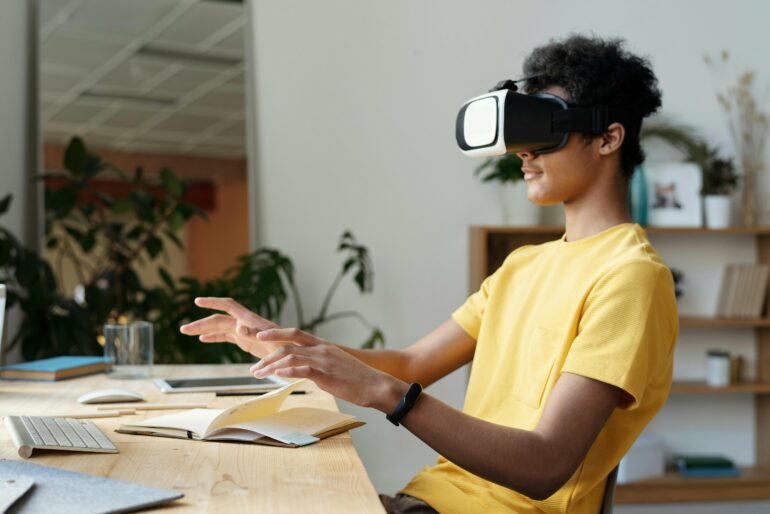
Empathy is not just a “nice-to-have” soft skill – it is a foundation of how children and adults regulate emotions, build friendships and learn from one another.
Between the ages of 6 and 9, children begin shifting from being self-centered to noticing the emotions and perspectives of others. This makes early childhood one of the most important periods for developing empathy and other social-emotional skills.
Traditionally, pretend play has been a natural way to practice empathy. Many adults can remember acting out scenes as doctor and patient, or using sticks and leaves as imaginary currency. Those playful moments were not just entertainment – they were early lessons in empathy and taking someone else’s perspective.
But as children spend more time with technology and less in pretend play, these opportunities are shrinking. Some educators worry that technology is hindering social-emotional learning. Yet research in affective computing – digital systems that recognize emotions, simulate them or both – suggests that technology can also become part of the solution.
Virtual reality, in particular, can create immersive environments where children interact with characters who display emotions as vividly as real humans. I’m a human-computer interaction scientist who studies social-emotional learning in the context of how people use technology. Used thoughtfully, the combination of VR and artificial intelligence could help reshape social-emotional learning practices and serve as a new kind of “empathy classroom” or “emotional regulation simulator.”
Game of emotions
As a part of my doctoral studies at the University of Florida, in 2017 I began developing a VR Empathy Game framework that combines insights from developmental psychology, affective computing and participatory design with children. At the Human-Computer Interaction Lab at the University of Maryland, I worked with their KidsTeam program, where children of 7-11 served as design partners, helping us to imagine what an empathy-focused VR game should feel like.
In 2018, 15 master’s students at the Florida Interactive Entertainment Academy at the University of Central Florida and I created the first game prototype, Why Did Baba Yaga Take My Brother? This game is based on a Russian folktale and introduces four characters, each representing a core emotion: Baba Yaga embodies anger, Goose represents fear, the Older Sister shows happiness and the Younger Sister expresses sadness.

The VR game Why Did Baba Yaga Take My Brother? is designed to help kids develop empathy.
Unlike most games, it does not reward players with points or badges. Instead, children can progress in the game only by getting to know the characters, listening to their stories and practicing empathic actions. For example, they can look at the game’s world through a character’s glasses, revisit their memories or even hug…

