Weather forecasting is a powerful tool. During hurricane season, for instance, meteorologists create computer simulations to forecast how these destructive storms form and where they might travel, which helps prevent damage to coastal communities. When you’re trying to forecast space weather, rather than storms on Earth, creating these simulations gets a little more complex. To simulate space weather, you would need to fit the Sun, the planets and the vast empty space between them in a virtual environment, also known as a simulation box, where all the calculations would take place.
Space weather is very different from the storms you see on Earth. These events come from the Sun, which ejects eruptions of charged particles and magnetic fields from its surface. The most powerful of these events are called interplanetary coronal mass ejections, or CMEs, which travel at speeds approaching 1,800 miles per second (2,897 kilometers per second).
To put that in perspective, a single CME could move a mass of material equivalent to all the Great Lakes from New York City to Los Angeles in just under two seconds – almost faster than it takes to say “space weather.”
When these CMEs hit Earth, they can cause geomagnetic storms, which manifest in the sky as beautiful auroras. These storms can also damage key technological infrastructure, such as by interfering with the flow of electricity in the power grid and causing transformers to overheat and fail.
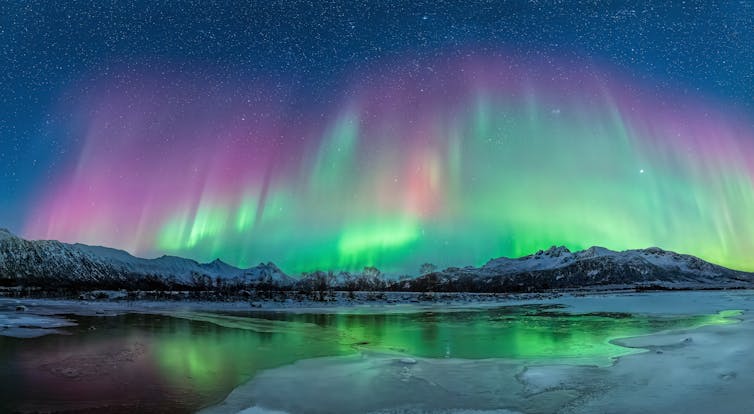
Geomagnetic storms, caused by space weather, produce beautiful light shows, but they can also damage satellites.
Frank Olsen, Norway/Moment via Getty Images
To better understand how these storms can wreak so much havoc, our research team created simulations to show how storms interact with Earth’s natural magnetic shield and trigger the dangerous geomagnetic activity that can shut down electric grids.
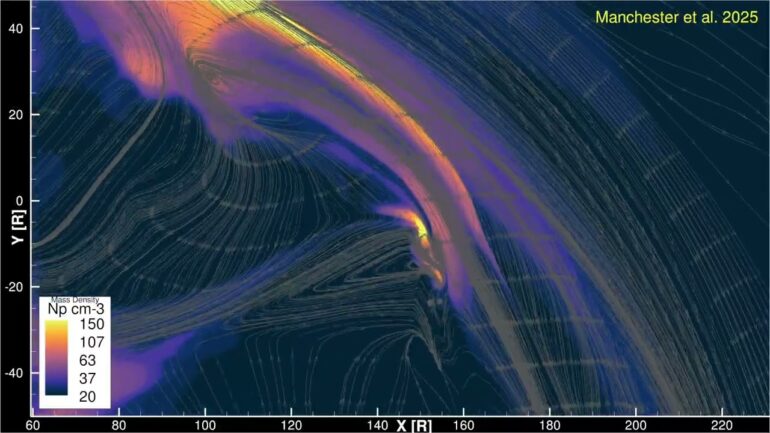
In a study published in October 2025 in the Astrophysical Journal, we modeled one of the sources of these geomagnetic storms: small, tornado-like vortices spun off of an ejection from the Sun. These vortices are called flux ropes, and satellites had previously observed small flux ropes – but our work helped uncover how they are generated.
The challenge
Our team started this research in summer 2023, when one of us, a space weather expert, spotted inconsistencies in space weather observations. This work had found geomagnetic storms occurring during periods when no solar eruptions were predicted to hit Earth.

Bewildered, the space weather expert wanted to know if there could be space weather events that were smaller than coronal mass ejections and did not originate directly from solar eruptions. He predicted that such events might form in the space between the Sun and Earth, instead of in the Sun’s atmosphere.
One example of such smaller space weather events is a magnetic flux rope – bundles of magnetic fields wrapped around each other like a…