
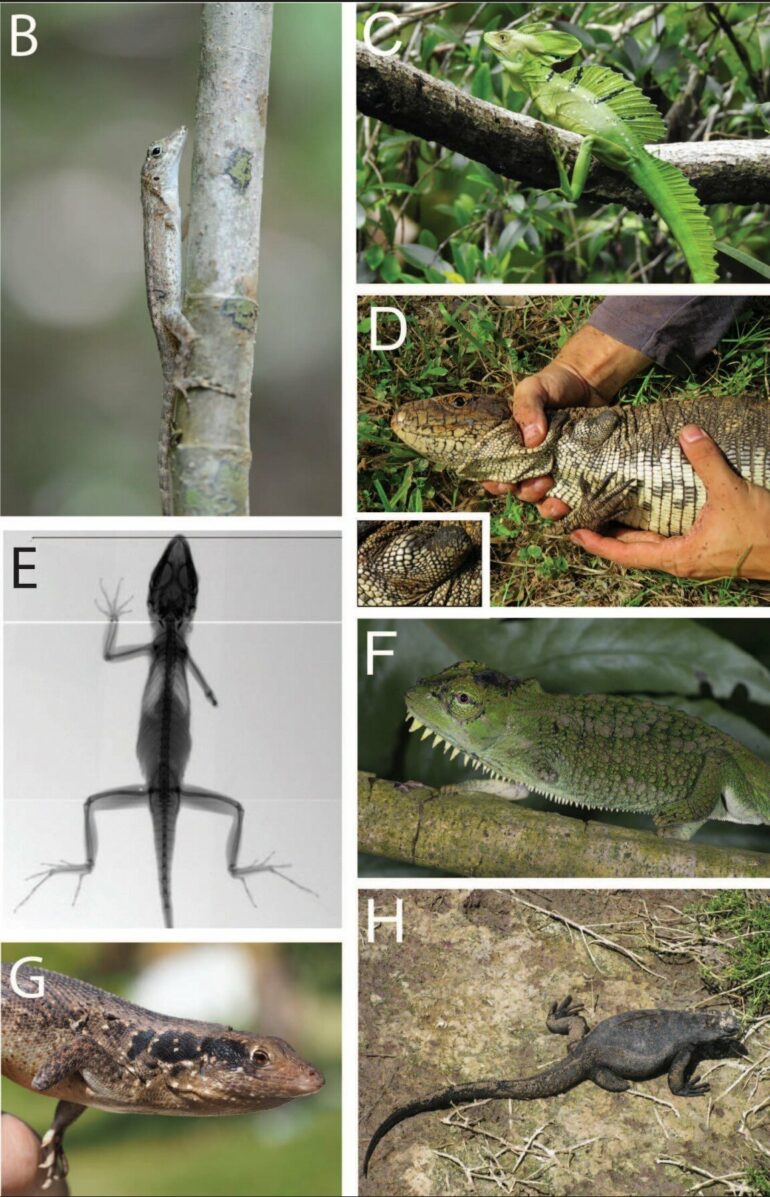
We are lizard biologists, and to do our work we need to catch lizards – never an easy task with such fast, agile creatures.
Years ago, one of us was in the Bahamas chasing a typically uncooperative lizard across dense and narrow branches, frustrated that its nimble agility was thwarting efforts to catch it. Only when finally captured did we discover this wily brown anole was missing its entire left hind leg. This astonishing observation set our research down an unexpected path.
That chance encounter led us to collaborate with over 60 colleagues worldwide to document what we suspected might be a broader phenomenon. Our research uncovered 122 cases of limb loss across 58 lizard species and revealed that these “three-legged pirates” – the rare survivors of traumatic injuries – can run just as fast, maintain healthy body weight, reproduce successfully and live surprisingly long lives.
To be clear, most lizards probably do not survive such devastating injuries. What we’re documenting are the exceptional cases that defy our expectations about how natural selection works.
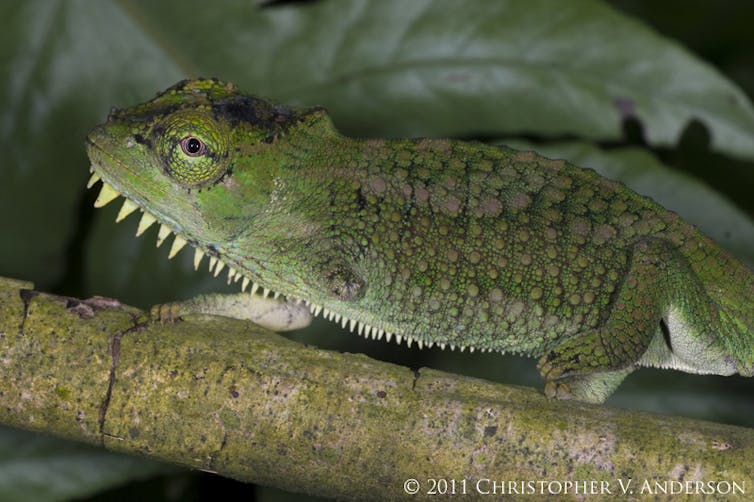
A four-horned chameleon missing its entire left forelimb in Cameroon appeared healthy when observed in the wild, despite the specialized gripping requirements of chameleons.
Christopher Anderson
This discovery is startling because lizard limbs represent one of biology’s most studied examples of evolutionary adaptation. For decades, scientists have demonstrated that even tiny differences in leg length between individual lizards can mean the difference between life and death – affecting their ability to escape predators, catch prey and find mates.
Since subtle variations matter so much, biologists have long assumed that losing an entire limb should be catastrophic.
Yet our global survey tells a different story about these remarkable survivors. Working with colleagues across six continents, we found limb-damaged lizards across nearly all major lizard families, from tiny geckos to massive iguanas.
These animals had clearly healed from whatever trauma caused their injuries – likely accidents or the failed attempts of a predator to eat them. Perhaps most remarkably, we documented surviving limb loss even in chameleons, tree-climbing specialists whose movements seem to require perfect limb coordination.

Thriving, not just surviving
The body condition of these lizards was most surprising. Rather than appearing malnourished, many limb-damaged lizards were actually heavier than expected for their size, suggesting they were successfully finding food despite their handicap. Some were actively reproducing, with females found carrying eggs and males observed successfully mating.
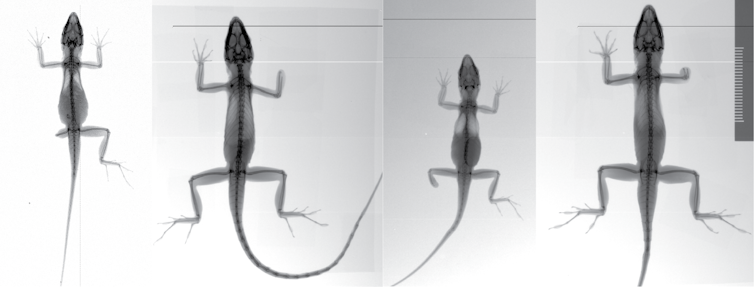
Limb damage can be fairly common in some lizard populations, such as these X-rays of brown anoles (Anolis sagrei) from the Bahamas.
Jason Kolbe/Jonathan Losos
These findings force us to reconsider some basic…