

In July 2025, Uganda’s courts swiftly dismissed a petition challenging the legality of polygamy, citing the protection of religious and cultural freedom. For most social scientists and policymakers who have long declared polygamy a “harmful cultural practice,” the decision was a frustrating but predictable setback in efforts to build healthier and more equal societies.
In the vast majority of cases, polygamy takes the form of one husband and multiple wives – more precisely referred to as polygyny, originating from the Greek words “poly” (“many”) and “gynē” (“woman or wife”). The opposite arrangement of one wife and multiple husbands is referred to as polyandry (from “anēr” meaning “man” or “husband”) and is exceedingly rare worldwide.
Critics of polygyny present two main arguments. First, they contend it squeezes low-status men out of the marriage market, fostering social unrest, crime and violence against women by frustrated unwed men. Second, it harms women and children by dividing limited resources among more dependents.
This logic has led leading political scientist Rose McDermott to describe polygyny as evil. Other researchers, such as anthropologist Joseph Henrich, even go as far as to credit Christianity’s derision of polygyny as a driving force of Western prosperity.
However, a trio of new studies, all relying on the highest standards of data analysis, contend that these arguments are misguided.
I have spent my career working at the intersection of anthropology and global health, researching how and why family structure varies – and what this diversity means for human well-being. Much of this work has been carried out with colleagues in Tanzania where, like Uganda, polygyny is relatively common. This new wave of work underscores the value of our research, effectively demonstrating that good intentions and intuition are no substitute for cultural sensitivity and evidence.
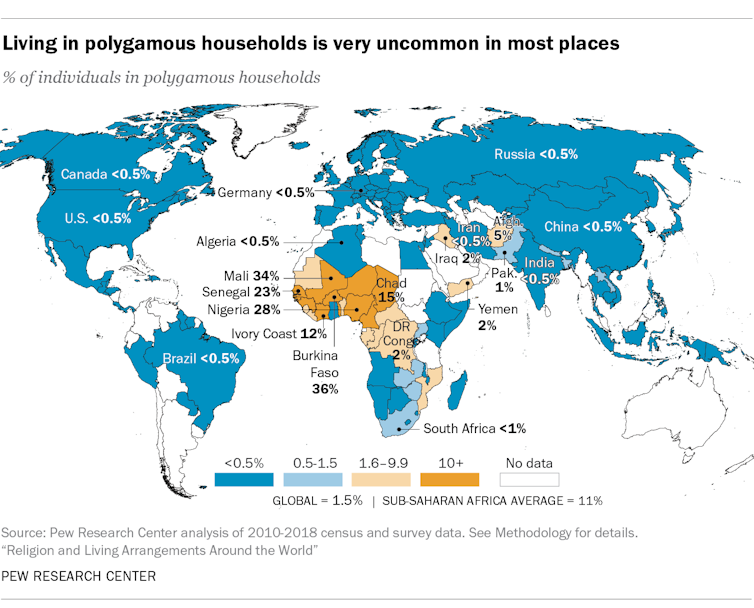
Only about 2% of the global population lives in polygamous households, and in most places the proportion is less than 0.5%.
Pew Research Center
Does polygyny lock men out of marriage?
A new study published in October 2025 in the Proceedings of the National Academy of Sciences presents the first comprehensive, large-scale analysis of polygyny and men’s marriage prospects. The project is a collaboration between demographer Hampton Gaddy and evolutionary anthropologists Rebecca Sear and Laura Fortunato.

The researchers drew on demographic modeling and an extraordinary trove of census data – over 84 million records from 30 countries in Africa, Asia and Oceania, plus the entire U.S. census from 1880, when polygyny was practiced in some American communities. They demonstrate that polygyny does not lock large numbers of men out of marriage. In fact, in many contexts, men are actually more likely to marry where polygyny is common than where it is rare.
The narrative that…

