

Scientists from the National University of Singapore (NUS) have discovered a simple DNA “switch” that helps tropical butterflies adjust the size of their wing eyespots in response to seasonal temperatures, shedding light on the evolution of environmental sensitivity. The findings could inform future efforts to understand and potentially bolster adaptation in a changing climate.
Insects often adapt in surprising ways to their surroundings. Some even change their colors with the seasons. This seasonal flexibility, called plasticity, helps them survive but its evolutionary origins have remained a mystery.
A team led by Professor Antónia Monteiro from the NUS Department of Biological Sciences, identified a stretch of DNA that helps certain butterflies switch their wing patterns between wet and dry seasons.
The research outcome has been published in the journal Nature Ecology & Evolution on 24 October 2025.
Prof Monteiro said, “Many tropical butterflies look strikingly different depending on whether they emerge in the dry or wet season. The African butterfly, Bicyclus anynana, the species we study, is one such example.”
In the wet season, these butterflies develop larger eyespots on their wings. During the dry season, these eyespots are smaller. These seasonal changes enhance survival in each environment.
Earlier work showed that the temperature at which caterpillars are reared triggers this size change, and that the pronounced temperature response is unique to the satyrid group of butterflies. This group of butterflies is characterized by their predominantly brown wings, which are often marked with distinctive eyespots.
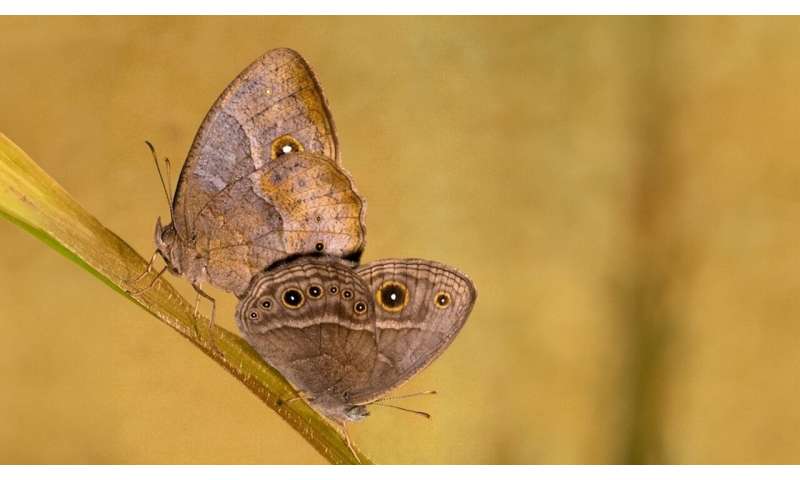
A mating pair of dry-season (left) and wet-season (right) B. anynana butterflies. © William Piel
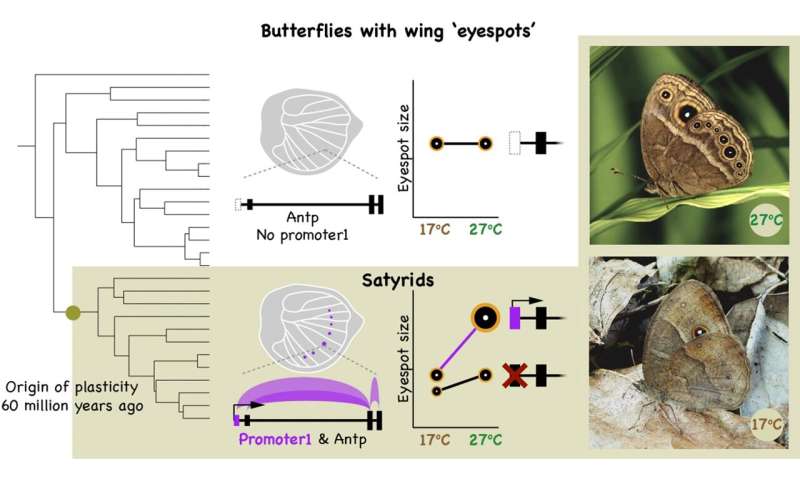
A simple genetic switch helps a clade of butterflies change their wing eyespot patterns in response to temperature. In satyrid butterflies, eyespots are larger when larvae are reared at higher temperatures (27°C) and smaller at cooler temperatures (17°C). An eyespot-specific promoter (shown in purple) activates the Antp gene in eyespot cells. Butterflies that carry this promoter have more temperature-sensitive eyespots, changing in size more dramatically at higher temperature than at lower temperature. The origin of this Antp promoter, the recruitment of the Antp gene to eyespots, and the evolution of eyespot size plasticity in response to temperature is inferred to have happened at around the same time—60 million years ago. © Tian Shen
In the new study, the team pinpointed a master instruction gene called Antennapedia (Antp), that controls how satyrid butterfly eyespots develop. They found that this gene becomes more or less active depending on the temperatures at which the butterflies were raised. Disrupting the activity of this gene in two different satyrid species reduced eyespot size, especially when the insects were raised at warmer temperatures, confirming Antp’s role in the seasonal size change.
The research team also discovered a previously unknown DNA switch (a “promoter”) that exists only in satyrid butterflies. This switch turns on the Antp gene specifically in eyespot central cells. Disabling the switch reduced the butterflies’ ability to adjust eyespot size with temperature, showing that this genetic element contributed to the evolution of their seasonal flexibility.

Dr. Tian Shen, the first author of the paper who conducted the research when he was a graduate student and postdoctoral fellow at NUS, said, “It is striking that a simple genetic switch can underlie complex environmental sensitivity across a broad group of insects. These findings open the door to future research into the roles such switches play in shaping adaptations, and to insights that could inform conservation in a changing climate.”
More information:
Shen Tian et al, A novel Hox gene promoter fuels the evolution of adaptive phenotypic plasticity in wing eyespots of satyrid butterflies, Nature Ecology & Evolution (2025). DOI: 10.1038/s41559-025-02891-5
Provided by
National University of Singapore
Citation:
Simple DNA switch helps tropical butterflies change wing patterns with the seasons (2025, October 24)