In May 2024, part of the Sun exploded.
The Sun is an immense ball of superheated gas called plasma. Because the plasma is conductive, magnetic fields loop out of the solar surface. Since different parts of the surface rotate at different speeds, the fields get tangled. Eventually, like rubber bands pulled too tight, they can snap – and that is what they did last year.
These titanic plasma explosions, also known as solar flares, each unleashed the energy of a million hydrogen bombs. Parts of the Sun’s magnetic field also broke free as magnetic bubbles loaded with billions of tons of plasma.
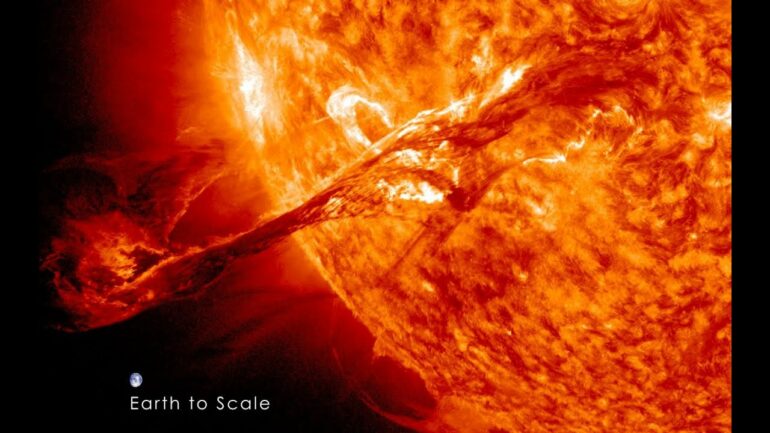
These bubbles, called coronal mass ejections, or CMEs, crashed through space at around 6,000 times the speed of a commercial jetliner. After a few days, they smashed one after another into the magnetic field that envelops Earth. The plasma in each CME surged toward us, creating brilliant auroras and powerful electrical currents that rippled through Earth’s crust.
A coronal mass ejection erupting from the Sun.
You might not have noticed. Just like the opposite poles of fridge magnets have to align for them to snap together, the poles of the magnetic field of Earth and the incoming CMEs have to line up just right for the plasma in the CMEs to reach Earth. This time they didn’t, so most of the plasma sailed off into deep space.
Humans have not always been so lucky. I’m an environmental historian and author of the new book “Ripples on the Cosmic Ocean: An Environmental History of Our Place in the Solar System.”
While writing the book, I learned that a series of technological breakthroughs – from telegraphs to satellites – have left modern societies increasingly vulnerable to the influence of solar storms, meaning flares and CMEs.
Since the 19th century, these storms have repeatedly upended life on Earth. Today, there are hints that they threaten the very survival of civilization as we know it.
The telegraph: A first warning
On the morning of Sept. 1, 1859, two young astronomers, Richard Carrington and Richard Hodgson, became the first humans to see a solar flare. To their astonishment, it was so powerful that, for two minutes, it far outshone the rest of the Sun.

About 18 hours later, brilliant, blood-red auroras flickered across the night sky as far south as the equator, while newly built telegraph lines shorted out across Europe and the Americas.
The Carrington Event, as it was later called, revealed that the Sun’s environment could violently change. It also suggested that emerging technologies, such as the electrical telegraph, were beginning to link modern life to the extraordinary violence of the Sun’s most explosive changes.
For more than a century, these connections amounted to little more than inconveniences, like occasional telegraph outages, partly because no solar storm rivaled the power of the Carrington Event. But another part of…