
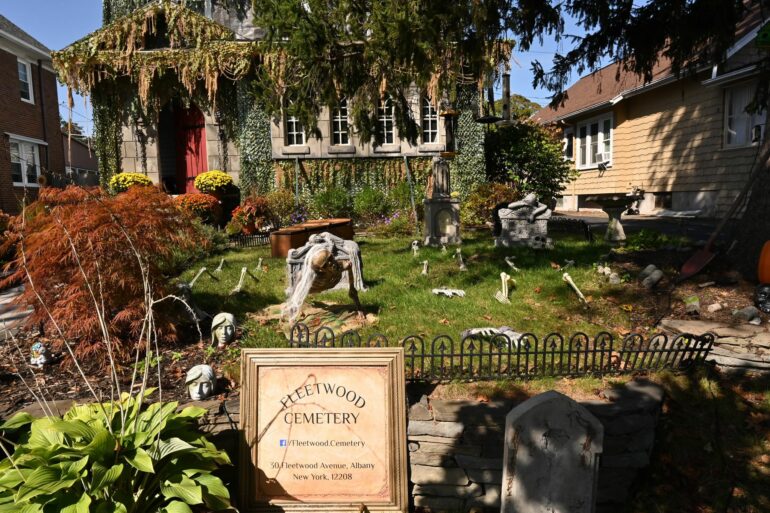
If you visit a cemetery, look closely and you’ll likely notice many flowering plants – adorning the graves, or maybe even carved into headstones.
As a horticulture Extension specialist and frequent geocacher, I often visit cemeteries in urban and rural areas across the country. The plants seen in cemeteries vary by climate as well as local history and culture. They are planted with purpose, often serving as symbols for the physical and spiritual realms.
Early rural cemeteries
In the early 1800s, cemeteries in the United States started separating from churchyards and common grounds of large cities, such as Boston Common. The population growth of cities quickly boxed in burial grounds, and they became overcrowded. The solution was rural cemeteries outside the city limits.
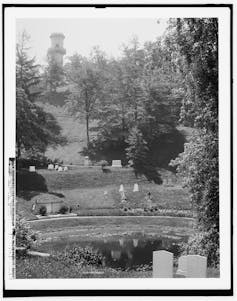
Mount Auburn Cemetery in Cambridge, Mass., between 1890 and 1901.
Heritage Art/Heritage Images via Getty Images
Mount Auburn, the first rural cemetery, was opened in 1831 in Cambridge, Massachusetts, in conjunction with the Massachusetts Horticultural Society. The developers kept the natural state in mind and drew inspiration from English landscape gardens and from a large cemetery in Paris: Père Lachaise – Napoleon’s solution for running out of space for burials in Paris.
Early rural cemeteries were closely linked with horticulture societies, and they became popular green spaces to visit to escape the pollution and crowds of the cities. The founder of one early rural cemetery, Laurel Hill outside Philadelphia, recorded all its plantings, representing over 175 different species, and created a guidebook.
Plants grown in cemeteries were selected not only based on whether they could grow in the climate, but also for the symbolism of their shapes and historical associations of their species. Plants frequently represented death and mourning, hope and immortality.
Weeping willow trees with their long, dangling branches were popular in cemeteries due to their dramatic emotional and visual effects. Evergreens symbolized eternal life. Deciduous trees represented the cycle of life because they lose their leaves in the winter, and flowers are comforting. Plants like iris and rose, which return every year, symbolized immortality.

Death in the Victorian era
Within a few decades of the beginning of the rural cemetery movement, the Victorian era began. Because of large numbers of dead from plagues and wars, death was a big part of Victorian life.
The Victorians were interested in floriography – “flower language” – and attached a symbolic meaning to almost every flower known. Consequently, flowers and other plants became commonplace on headstones.
This emphasis on botanical motifs on headstones contrasted the symbols that had been common on early gravestones in New England during colonial days. Many gravestones from those days had images such as winged skulls and crossed bones, representing the orthodox Puritan view…