
People often take walking for granted. We just move, one step after another, without ever thinking about what it takes to make that happen. Yet every single step is an extraordinary act of coordination, driven by precise timing between spinal cord, brain, nerves, muscles and joints.
Historically, people have used stopwatches, cameras or trained eyes to assess walking and its deficits. However, recent technological advances such as motion capture, wearable sensors and data science methods can record and quantify characteristics of step-by-step movement.
We are researchers who study biomechanics and human performance. We and other researchers are increasingly applying this data to improve human movement. These insights not only help athletes of all stripes push their performance boundaries, but they also support movement recovery for patients through personalized feedback. Ultimately, motion could become another vital sign.
From motion data to performance insights
Researchers around the world combine physiology, biomechanics and data science to decode human movement. This interdisciplinary approach sets the stage for a new era where machine learning algorithms find patterns in human movement data collected by continuous monitoring, yielding insights that improve health.
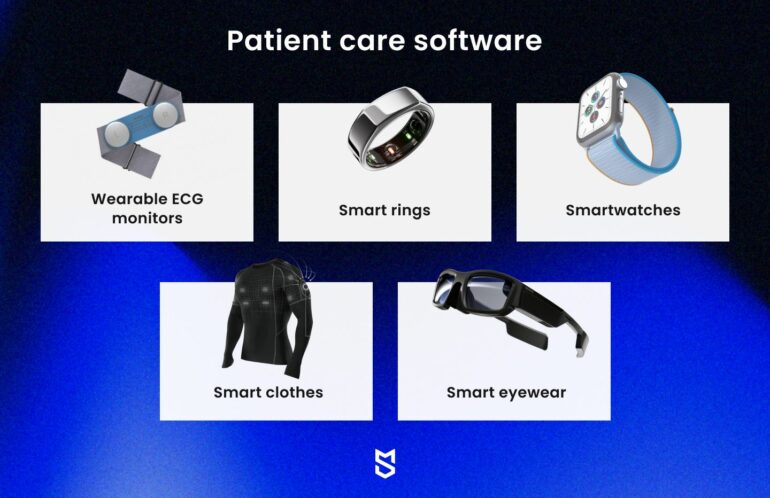
It’s the same technology that powers your fitness tracker. For example, the inertial measurement unit in the Apple Watch records motion and derives metrics such as step count, stride length and cadence. Wearable sensors, such as inertial measurement units, record thousands of data points every second. The raw data reveals very little about a person’s movement. In fact, the data is so noisy and unstructured that it’s impossible to extract any meaningful insight.
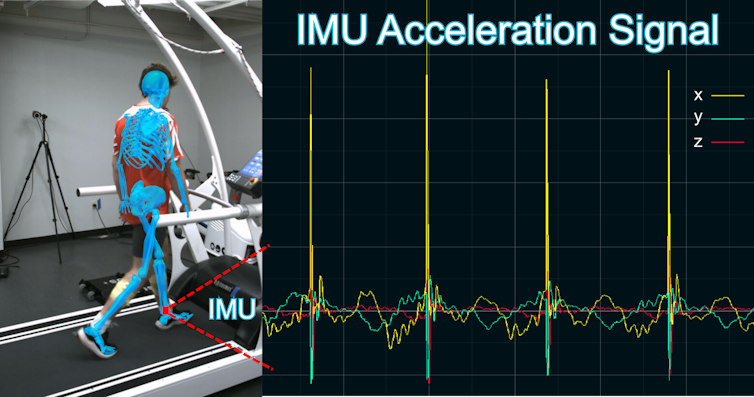
A study participant walks on a treadmill in our lab while a motion sensor attached to the subject’s ankle captures acceleration signals.
Human Performance and Nutrition Research Institute
That is where signal processing comes into play. A signal is simply a sequence of measurements tracked over time. Imagine putting an inertial measurement unit on your ankle. The device constantly tracks the ankle’s movement by measuring signals such as acceleration and rotation. These signals provide an overview of the motion and indicate how the body behaves. However, they often contain unwanted background noise that can blur the real picture.

With mathematical tools, researchers can filter out the noise and isolate the information that truly reflects how the body is performing. It’s like taking a blurry photo and using editing tools to make the picture clear. The process of cleaning and manipulating the signals is known as signal processing.
After processing the signals, researchers use machine learning techniques to transform them into interpretable metrics. Machine learning is a subfield of artificial intelligence that works by finding patterns and relationships in…