
In the home, the lab and the factory, electric fields control technologies such as Kindle displays, medical diagnostic tests and devices that purify cancer drugs. In an electric field, anything with an electrical charge – from an individual atom to a large particle – experiences a force that can be used to push it in a desired direction.
When an electric field pushes charged particles in a fluid, the process is called electrophoresis. Our research team is investigating how to harness electrophoresis to move tiny particles – called nanoparticles – in porous, spongy materials. Many emerging technologies, including those used in DNA analysis and medical diagnostics, use these porous materials.
Figuring out how to control the tiny charged particles as they travel through these environments can make them faster and more efficient in existing technologies. It can also enable entirely new smart functions.
Ultimately, scientists are aiming to make particles like these serve as tiny nanorobots. These could perform complex tasks in our bodies or our surroundings. They could search for tumors and deliver treatments or seek out sources of toxic chemicals in the soil and convert them to benign compounds.
To make these advances, we need to understand how charged nanoparticles travel through porous, spongy materials under the influence of an electric field. In a new study, published Nov. 10, 2025, in the Proceedings of the National Academy of Sciences, our team of engineering researchers led by Anni Shi and Siamak Mirfendereski sought to do just that.
Weak and strong electric fields
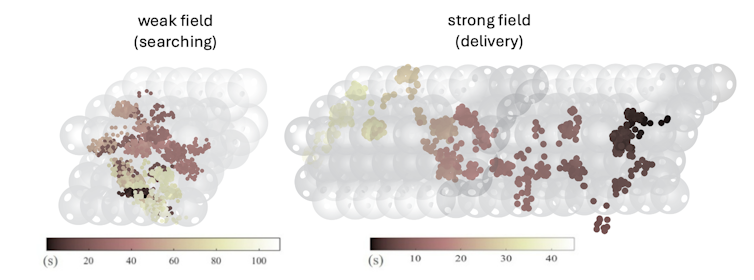
Imagine a nanoparticle as a tiny submarine navigating a complex, interconnected, liquid-filled maze while simultaneously experiencing random jiggling motion. While watching nanoparticles move through a porous material, we observed a surprising behavior related to the strength of the applied electric field.
A weak electric field acts only as an accelerator, boosting the particle’s speed and dramatically improving its chance of finding any exit from a cavity, but offering no directional guidance – it’s fast, but random.
In contrast, a strong electric field provides the necessary “GPS coordinates,” forcing the particle to move rapidly in a specific, predictable direction across the network.
This discovery was puzzling but exciting, because it suggested that we could control the nanoparticles’ motion. We could choose to have them move fast and randomly with a weak field or directionally with a strong field.
The former allows them to search the environment efficiently while the latter is ideal for delivering cargo. This puzzling behavior prompted us to look more closely at what the weak field was doing to the surrounding fluid.