
“Time flies,” “time waits for no one,” “as time goes on”: The way we speak about time tends to strongly imply that the passage of time is some sort of real process that happens out there in the world. We inhabit the present moment and move through time, even as events come and go, fading into the past.
But go ahead and try to actually verbalize just what is meant by the flow or passage of time. A flow of what? Rivers flow because water is in motion. What does it mean to say that time flows?
Events are more like happenings than things, yet we talk as though they have ever-changing locations in the future, present or past. But if some events are future, and moving toward you, and some past, moving away, then where are they? The future and past don’t seem to have any physical location.
Human beings have been thinking about time for as long as we have records of humans thinking about anything at all. The concept of time inescapably permeates every single thought you have about yourself and the world around you. That’s why, as a philosopher, philosophical and scientific developments in our understanding of time have always seemed especially important to me.
Ancient philosophers on time
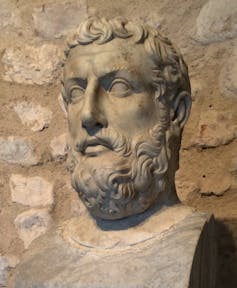
Parmenides of Elea was an early Greek philosopher who thought about the passage of time.
Sergio Spolti/Wikimedia Commons, CC BY-SA
Ancient philosophers were very suspicious about the whole idea of time and change. Parmenides of Elea was a Greek philosopher of the sixth to fifth centuries BCE. Parmenides wondered, if the future is not yet and the past is not anymore, how could events pass from future to present to past?
He reasoned that, if the future is real, then it is real now; and, if what is real now is only what is present, the future is not real. So, if the future is not real, then the occurrence of any present event is a case of something inexplicably coming from nothing.
Parmenides wasn’t the only skeptic about time. Similar reasoning regarding contradictions inherent in the way we talk about time appears in Aristotle, in the ancient Hindu school known as the Advaita Vedanta and in the work of Augustine of Hippo, also known as St. Augustine, just to name a few.
Einstein and relativity
The early modern physicist Isaac Newton had presumed an unperceived yet real flow of time. To Newton, time is a dynamic physical phenomenon that exists in the background, a regular, ticking universe-clock in terms of which one can objectively describe all motions and accelerations.
Then, Albert Einstein came along.

In 1905 and 1915, Einstein proposed his special and general theories of relativity, respectively. These theories validated all those long-running suspicions about the very concept of time and change.
Relativity rejects Newton’s notion about time as a universal physical phenomenon.
By Einstein’s era, researchers had shown that the speed of light is a constant, regardless of the…