
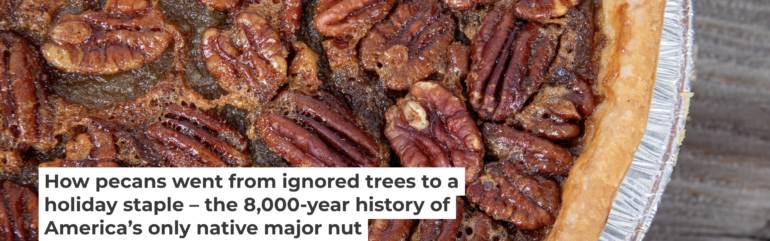
Pecans have a storied history in the United States. Today, American trees produce hundreds of million of pounds of pecans – 80% of the world’s pecan crop. Most of that crop stays here. Pecans are used to produce pecan milk, butter and oil, but many of the nuts end up in pecan pies.
Throughout history, pecans have been overlooked, poached, cultivated and improved. As they have spread throughout the United States, they have been eaten raw and in recipes. Pecans have grown more popular over the decades, and you will probably encounter them in some form this holiday season.
I’m an extension specialist in Oklahoma, a state consistently ranked fifth in pecan production, behind Georgia, New Mexico, Arizona and Texas. I’ll admit that I am not a fan of the taste of pecans, which leaves more for the squirrels, crows and enthusiastic pecan lovers.
The spread of pecans
The pecan is a nut related to the hickory. Actually, though we call them nuts, pecans are actually a type of fruit called a drupe. Drupes have pits, like the peach and cherry.
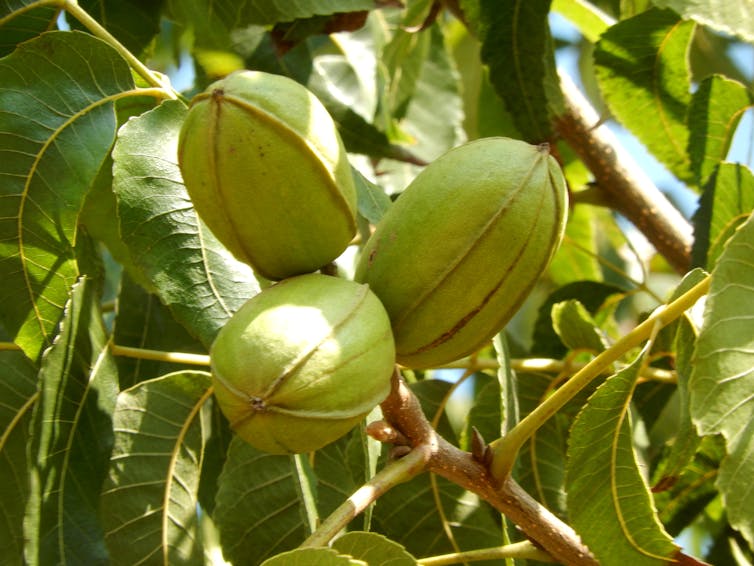
Three pecan fruits, which ripen and split open to release pecan nuts, clustered on a pecan tree.
IAISI/Moment via Getty Images
The pecan nuts that look like little brown footballs are actually the seed that starts inside the pecan fruit – until the fruit ripens and splits open to release the pecan. They are usually the size of your thumb, and you may need a nutcracker to open them. You can eat them raw or as part of a cooked dish.
The pecan derives its name from the Algonquin “pakani,” which means “a nut too hard to crack by hand.” Rich in fat and easy to transport, pecans traveled with Native Americans throughout what is now the southern United States. They were used for food, medicine and trade as early as 8,000 years ago.
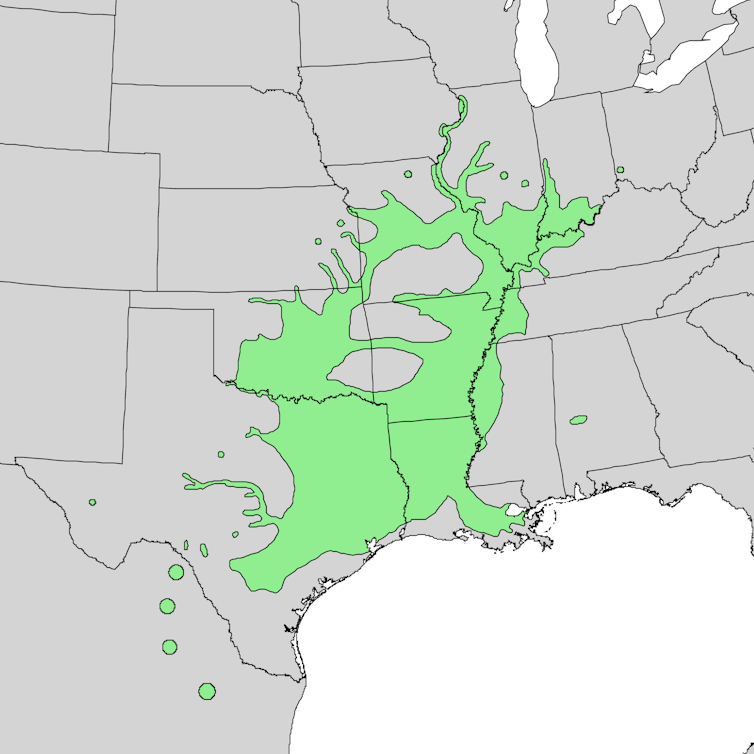

Pecans are native to the southern United States.
Elbert L. Little Jr. of the U.S. Department of Agriculture, Forest Service
Pecans are native to the southern United States, and while they had previously spread along travel and trade routes, the first documented purposeful planting of a pecan tree was in New York in 1722. Three years later, George Washington’s estate, Mount Vernon, had some planted pecans. Washington loved pecans, and Revolutionary War soldiers said he was constantly eating them.
Meanwhile, no one needed to plant pecans in the South, since they naturally grew along riverbanks and in groves. Pecan trees are alternate bearing: They will have a very large crop one year, followed by one or two very small crops. But because they naturally produced a harvest with no input from farmers, people did not need to actively cultivate them. Locals would harvest nuts for themselves but otherwise ignored the self-sufficient trees.
It wasn’t until the late 1800s that people in the pecan’s native range realized the pecan’s potential worth for income and trade. Harvesting pecans…

