
Curious Kids is a series for children of all ages. If you have a question you’d like an expert to answer, send it to [email protected].
How will the universe end? – Iez M., age 9, Rochester, New York
Whether the universe will “end” at all is not certain, but all evidence suggests it will continue being humanity’s cosmic home for a very, very long time.
The universe – all of space and time, and all matter and energy – began about 14 billion years ago in a rapid expansion called the Big Bang, but since then it has been in a state of continuous change. First, it was full of a diffuse gas of the particles that now make up atoms: protons, neutrons and electrons. Then, that gas collapsed into stars and galaxies.
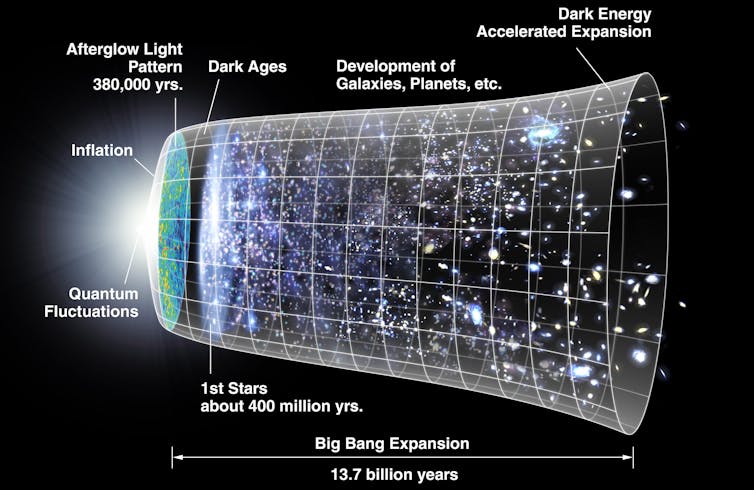
Our current theory for the history of the universe. On the left is the Big Bang roughly 14 billion years ago. The structure and makeup of the universe have changed over time.
NASA/WMAP Science Team
Our understanding of the future of the universe is informed by the objects and processes we observe today. As an astrophysicist, I observe objects like distant galaxies, which lets me study how stars and galaxies change over time. By doing so, I develop theories that predict how the universe will change in the future.
Predicting the future by studying the past?
Predicting the future of the universe by extending what we see today is extrapolation. It’s risky, because something unexpected could happen.
Interpolation – connecting the dots within a dataset – is much safer. Imagine you have a picture of yourself when you were 5 years old, and then another when you were 7 years old. Someone could probably guess what you looked like when you were 6. That’s interpolation.
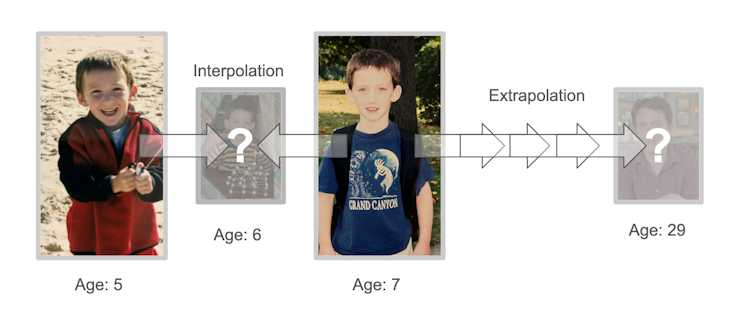

Using a picture of the author when he was 5 years old and 7 years old, you could interpolate what he looked like when he was 6 years old, but you couldn’t predict what he would look like at 29.
Stephen DiKerby
Maybe they could extrapolate from the two pictures to what you’d look like when you are 8 or 9 years old, but no one can accurately predict too far into the future. Maybe in a few years you get glasses or suddenly get really tall.
Scientists can predict what the universe will probably look like a few billion years into the future by extrapolating how stars and galaxies change over time, but eventually things could get weird. The universe and the stuff within might once again change, like it has in the past.
How will stars change in the future?
Good news: The Sun, our medium-sized yellow star, is going to continue shining for billions of years. It’s about halfway through its 10 billion-year lifetime. The lifetime of a star depends on its size. Big, hot, blue stars live shorter lives, while tiny, cool, red stars live for much longer.
Today, some galaxies are still producing new stars, but others have…