In 2026, astronauts will travel around the Moon for the first time since the Apollo era, powerful new space telescopes will prepare to survey billions of galaxies, and multiple nations will launch missions aimed at finding habitable worlds, water on the Moon and clues to how our solar system formed.
Together, these launches will mark a turning point in how humanity studies the universe – and how nations cooperate and compete beyond Earth. Coming from one of the world’s largest astrophysical research institutes, I can tell you, the anticipation across the global space science community is electric.
Mapping the cosmos at unprecedented scales
Several of the most ambitious missions slated for launch in 2026 share a common goal: to map the universe on the largest possible scales and reveal how planets, galaxies and the largest cosmic structures evolved over billions of years.
The centerpiece of this effort is NASA’s Nancy Grace Roman Space Telescope. Construction completed on the Roman telescope in December at NASA’s Goddard Space Flight Center, and if all goes well, it could launch as early as fall 2026.
What makes Roman more special than NASA’s other flagship space telescopes is not just what it will see, but how much of the sky it can see at once. Its 300-megapixel camera can capture regions of sky about 100 times larger than the Hubble Space Telescope’s field of view while maintaining comparable sharpness – like switching from studying individual tiles to surveying the entire mosaic at once.
During its five-year primary mission, Roman is expected to discover more than 100,000 distant exoplanets, map billions of galaxies strewn across cosmic time and help scientists probe dark matter and dark energy – the invisible scaffolding and mysterious forces that together account for 95% of the cosmos.
Roman also carries a coronagraph, a pathfinder instrument that can block out a star’s blinding light to directly photograph planets orbiting around it. The technology could pave the way for future missions, like NASA’s planned Habitable Worlds Observatory, capable of searching for signs of life on Earth-like worlds.

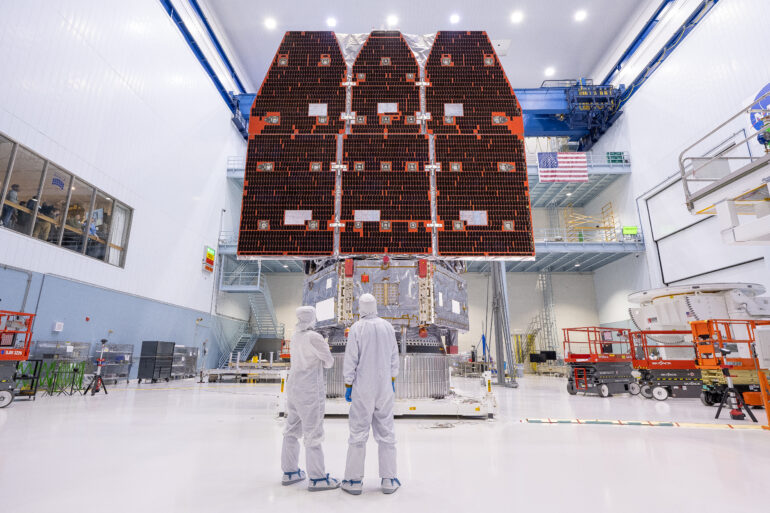
NASA’s Nancy Grace Roman Space Telescope is now fully assembled following the integration of its two major segments on Nov. 25, 2025, at the agency’s Goddard Space Flight Center in Greenbelt, Md. The mission is slated to launch by May 2027, but the team is on track for launch as early as fall 2026.
NASA/Jolearra Tshiteya
Over in Europe, the European Space Agency’s PLATO mission, short for PLAnetary Transits and Oscillations of stars mission, is scheduled to launch in December 2026 aboard Europe’s new Ariane 6 rocket. PLATO will monitor about 200,000 stars using an array of 26 cameras, searching for small, rocky planets in their stars’ habitable zones, while also determining the stars’ ages.
For China, 2026 is expected to mark a milestone of a different…