
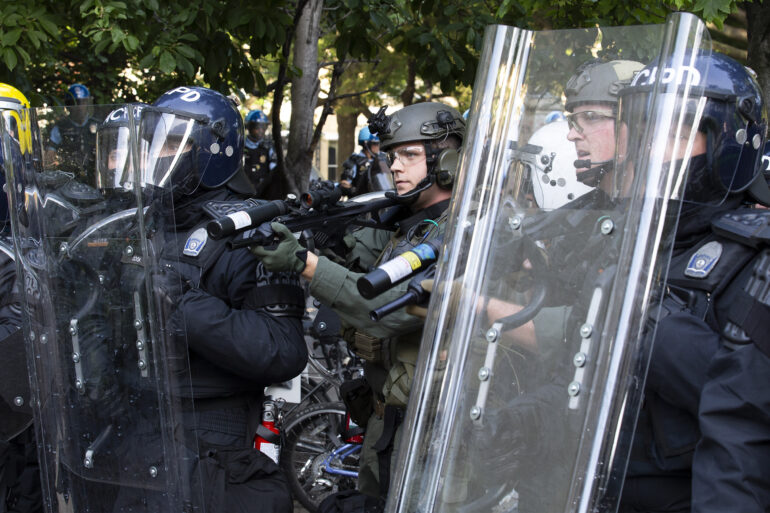
Images and videos from Minneapolis, Chicago and other U.S. cities show masked Immigration and Customs Enforcement and Border Patrol agents in military-style gear pointing weapons at people protesting or observing immigration enforcement actions. These are not typical firearms; they are riot control agents, and they emit cascades of projectiles or plumes of smoke.
In other scenes unfolding in cities across the country, officers launch metal canisters that explode loudly and scatter blinding flashes of light. The people targeted are shown screaming, disoriented and in some cases bleeding after being struck at close range. Those enveloped by smoke frequently cough and gasp for air.
What exactly are these weapons? What do they do to the human body? Are there rules governing their use? And what are their short- and long-term health effects?
As physician-researchers who have investigated the health consequences of human rights violations for decades, including misuse of so-called less lethal weapons in multiple countries, including the United States, we have studied how these tools are deployed and the harms that can result.
What are less lethal weapons?
U.S. law enforcement and federal agents deploy four main categories of crowd-control weapons: chemical irritants, kinetic impact projectiles known as KIPs, disorientation devices and electronic control weapons.
These weapons have been dubbed “less lethal” compared with live ammunition. But “less lethal” does not mean harmless. They can cause pain, fear and physiological stress and can result in serious injury or death.

An ICE agent deploys a canister of tear gas near protesters in Minneapolis.
AP Photo/Adam Gray
Chemical irritants, commonly called tear gas, cause intense pain and irritation of the eyes, skin and upper respiratory tract. They trigger coughing, breathing difficulty, disorientation, vomiting and panic. Delivered through sprays, pellets or canisters, they are inherently indiscriminate, affecting anyone in the area.

The most widely used agents in tear gas include chlorobenzylidene malononitrile, CS for short, and oleoresin capsicum, or OC, also called pepper spray. OC contains capsaicin, which is the compound that gives chiles their burning heat, at concentrations thousands of times stronger than those found in natural peppers. A synthetic version known as PAVA is also sometimes used. The amount, composition and concentration released can vary widely by manufacturer and country and remain largely unregulated. The spray can eject forcefully, reaching up to 20 feet depending on the canister design.

Unlike pepper spray, CS gas – the key ingredient in tear gas – doesn’t contain capcaisin. CS is a solid that is dispersed as tiny particles when burned in a canister.
Andy Brunning/Compound Interest 2020, CC BY-NC-ND
Kinetic impact projectiles transfer energy from a moving object into…