
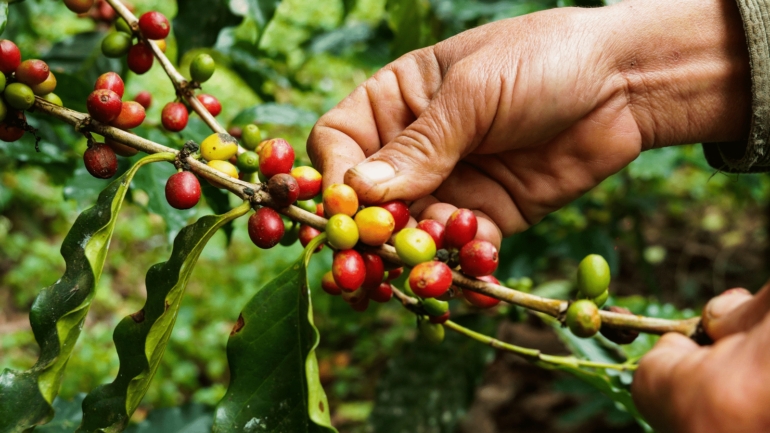
For anyone who relies on coffee to start their day, coffee wilt disease may be the most important disease you’ve never heard of. This fungal disease has repeatedly reshaped the global coffee supply over the past century, with consequences that reach from African farms to cafe counters worldwide.
Infection with the fungus Fusarium xylarioides results in a characteristic “wilt” in coffee plants by blocking and reducing the plant’s ability to transport water. This blockage eventually kills the plant.
Some of the most destructive plant pathogens in the world infect their hosts in this way. Since the 1990s, outbreaks of coffee wilt have cost over US$1 billion, forced countless farms to close and caused dramatic drops in national coffee production. In Uganda, one of Africa’s largest producers, coffee production did not recover to pre-outbreak levels until 2020, decades after coffee wilt was first detected there. And in 2023, researchers found evidence that coffee wilt disease had resurfaced across all coffee-producing regions of Ivory Coast.
Studying the genetics of plant pathogens is crucial to understanding why this disease continues to return and how to prevent another major outbreak.
Rise and fall of coffee wilt disease in Africa
While early outbreaks of coffee wilt disease affected a wide range of coffee types, later epidemics primarily affected the two coffee species dominating global markets today: arabica and robusta.
First identified in 1927, coffee wilt disease decimated several varieties of coffee grown in western and central Africa. Although farmers combated the fungus with a shift to supposedly resistant robusta crops in the 1950s, the reprieve was short-lived.
The disease reemerged in the 1970s on robusta coffee, spreading through eastern and central Africa. By the mid-1990s, yields had collapsed and coffee production could not recover in countries like the Democratic Republic of Congo.
Separately, researchers identified the disease on arabica coffee in Ethiopia in the 1950s and watched it become widespread by the 1970s

Coffee wilt disease has spread widely in Africa. The first outbreak before the 1950s affected mainly central and western Africa (left map) while the second outbreak originated in central Africa and spread east (right map). Affected countries are colored by the decade the disease was first detected.
Peck et al 2023/Plant Pathology, CC BY-SA
Although coffee wilt disease is currently endemic at low and manageable levels across eastern and central Africa, any future resurgence of the disease could be catastrophic for African coffee production. Coffee wilt also poses a threat to producers in Asia and the Americas.
New types of disease emerge
Coffee wilt disease evolved alongside coffee itself. Over the past century, it has repeatedly reemerged, attacking different types of coffee each time. But did these shifts reflect the rapid evolution of new types of…