
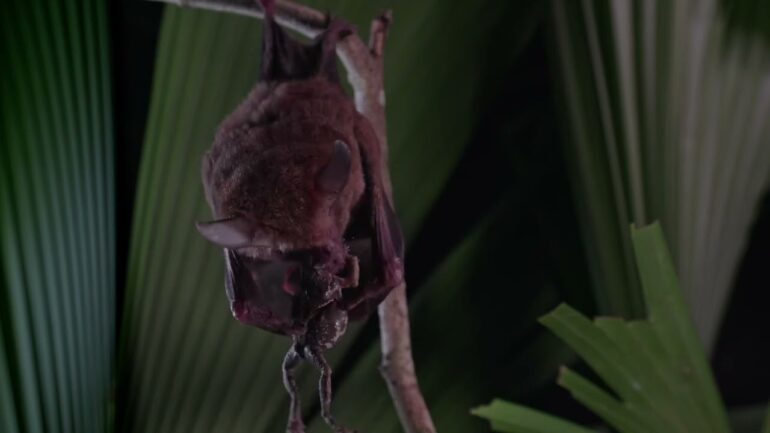
Deep into the Panamanian night, the forest hums with sound. Chirping insects form a steady backdrop, rain softly trickles from leaves. Somewhere above a stream, frogs call into the darkness.
But I am not there to see this scene.
It’s already passed. What I hold now is a small, mud-smeared biologger, no larger than a Lego brick. This tag recorded the sounds of the previous night.

Deep in the jungle of Soberanía National Park, researchers Gregg Cohen, Leonie Baier and Sebastian Mortensen process fringe-lipped bats under red-light headlamps. The nonintrusive light minimizes disturbance as the team weighs, measures and assesses each bat before tagging it.
Imran Razik, Smithsonian Tropical Research Institute, CC BY-SA
The evening before, my team and I had set nets outside the roosts – hollow trees or human-made structures such as tunnels or bunkers – where fringe-lipped bats (Trachops cirrhosus) sleep during the day. Under the faint glow of red headlamps, we weighed each bat we caught on its way out of the roost, checked its age and sex, and carefully glued a tiny tag to the fur between its shoulder blades.
When we released a tagged bat into the darkness, it vanished into the trees, carrying our recorder into the night.
The researchers carefully release the tagged bats into the night. Eric de Framond
Within a few days, the tags either fell off naturally or I gently removed them from recaptured bats with a quick trim of fur. Each biologger captured five to six hours of continuous sound and movement data – every flight, every attack, every crunch of prey bones between sharp teeth.
For the first time, I could follow a predator through the forest from its own point of view. And what those recordings revealed surprised me: Our fringe-lipped bats don’t simply grab the first thing they detect. Instead, they stalk the forest’s creatures with a patience and precision I hadn’t expected.

Once a bat is recaptured, no chances are taken that it might fly off with its precious load – the biologger holding all the data – still attached. Here, Leonie Baier works under a mosquito net to safely remove the tag before releasing the bat, tag-free.
Eric de Framond, Smithsonian Tropical Research Institute, CC BY-SA
Tiny tags for tiny hunters
I’m a behavioral ecologist, and fringe-lipped bats have been part of my scientific life for years, through my work with animal behavior researcher Rachel Page at the Smithsonian Tropical Research Institute in Panama. In our recent study published in the journal Current Biology, we paired decades of field knowledge with miniature biologging technology, allowing us to accompany the bats through the night.
When I plug a tag into my laptop, I follow that journey in sound and movement. Through my headphones, I hear a familiar note. A túngara frog…