
From hypersonic aircraft to nuclear-powered submarines, many of today’s most advanced defense systems rely on a special class of materials known as refractory alloys. This class refers to metals that do not melt or weaken easily, even in extreme heat.
An alloy is a material made by combining two or more metallic elements to achieve properties no single metal can offer on its own – greater strength, for example, or better resistance to corrosion. Refractory alloys are based on elements such as tungsten, niobium and molybdenum, which have some of the highest melting points of any metals.
Their atoms are held together by strong chemical bonds and arranged in a stable crystal structure that resists deforming, even at extreme temperatures. Where conventional alloys begin to soften and slowly deform under constant stress, refractory alloys retain their strength, making them essential for components exposed to extreme heat, stress and radiation.
Most refractory alloys in service today were designed decades ago. They predate modern 3D printing of metal parts, also called additive manufacturing, and artificial intelligence.
To execute metal 3D printing, a laser or electron beam melts successive thin layers of metal powder.
This builds up a 3D part directly from a computer model by adding material layer by layer, rather than using molds or removing material from a solid block. 3D printing allows shapes that are impossible with traditional manufacturing methods. However, many current refractory alloys are difficult or impossible to manufacture reliably using these techniques.
This mismatch can slow the domestic production of new parts. To help address these manufacturing and supply-chain challenges, our team of materials researchers at Arizona State University and UNSW Sydney has formed a new international collaboration to redesign high-temperature alloys.
Old alloys in a new manufacturing world
Additive manufacturing allows defense and aerospace manufacturers to produce complex components locally, on demand and with far less material waste. In principle, it is ideal for producing replacement parts for aircraft, spacecraft and naval systems.

In practice, many refractory alloys crack, warp or develop internal defects when 3D-printed. Their compositions were optimized for casting or forging, not for the rapid melting and solidification involved in laser-based printing. In 3D printing, a laser melts and resolidifies metal thousands of times in quick succession, creating steep temperature gradients that generate enormous internal stresses. Several key refractory metals are brittle at room temperature and cannot absorb those stresses without cracking.

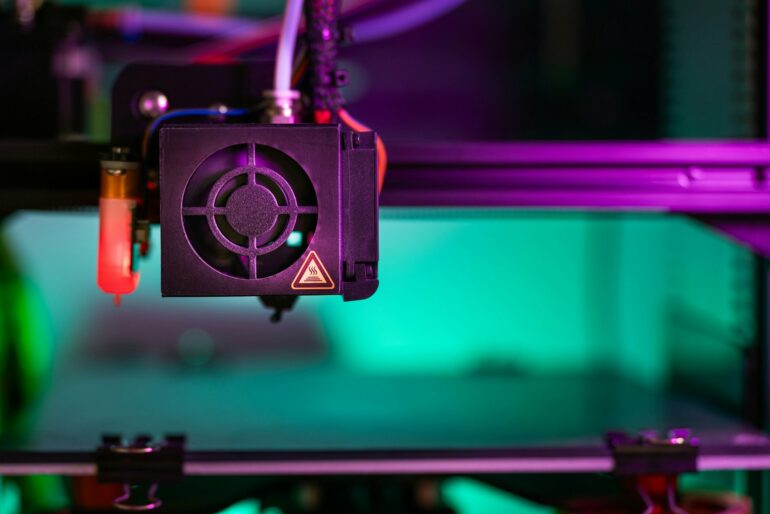
3D printers deposit thin layers of material on top of each other until they build up the part based on the design.
brightstars/Photographer’s Choice RF via Getty Images
Redesigning these alloys using traditional trial-and-error methods would take…