President Donald Trump directed the Pentagon and other federal agencies to begin releasing government files related to UFOs and unidentified anomalous phenomena – called UAP – in February 2026, following years of pressure from Congress, military whistleblowers and the public.
Congress formally mandated UAP investigations through the National Defense Authorization Act in December 2022. The Pentagon’s official UAP investigative body, the All-domain Anomaly Resolution Office, AARO, now carries a caseload exceeding 2,000 reports dating back to 1945. Defense Secretary Pete Hegseth confirmed this figure earlier this year.
The cases were submitted by military personnel, pilots and government employees describing aerial objects that could not be explained as known aircraft, drones or weather phenomena. Governments in Japan, France, Brazil and Canada also have their own formal UAP investigation programs.
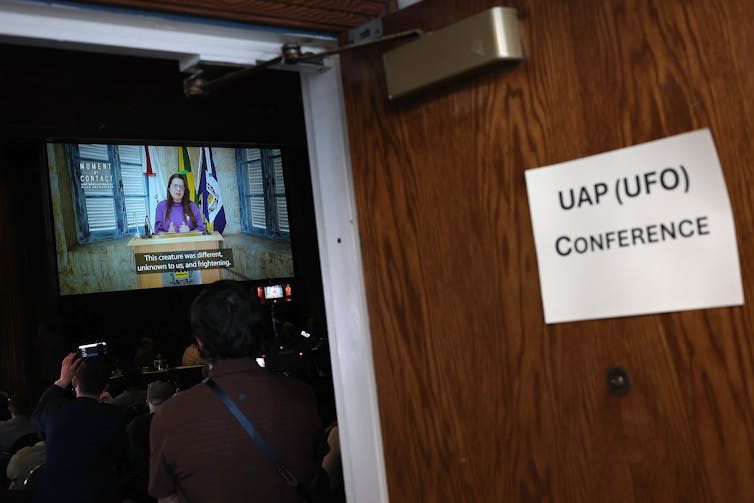
Filmmaker James Fox organized a press conference on UAP and UFO encounters, held at the National Press Club on Jan. 20, 2026, in Washington, D.C. It focused on a 1996 suspected UFO crash in Brazil.
Kevin Dietsch/Getty Images
Yet modern research universities remain almost entirely absent from this conversation. No major university has established a dedicated UAP research center. No federal science agency offers competitive grants for UAP inquiry. No doctoral programs train researchers in UAP methodology. The gap between what governments openly acknowledge and what universities are willing to study is, at this point, difficult to explain on purely intellectual grounds.
I have navigated this gap while conducting my own UAP research. My work developing the temporal aerospace correlation tool, a standardized framework for correlating civilian UAP sighting reports with documented rocket launch activity from Cape Canaveral, is currently under peer review at Limina: The Journal of UAP Studies.
Designing that framework meant making methodological decisions without community standards, without institutional funding and without the professional infrastructure many researchers in established fields take for granted. What is missing is not interest or data – it is the shared scaffolding that turns isolated curiosity into cumulative science.
Stigma is measurable
The most rigorous evidence for the gap between faculty interest in UAP and faculty willingness to study it UAP comes from peer-reviewed studies by Marissa Yingling, Charlton Yingling and Bethany Bell, published in the scholarly journal Humanities and Social Sciences Communications.
Across 14 disciplines at 144 major U.S. research universities, 1,460 faculty responded to their 2023 national survey. Most surveyed believed UAP research was important. Curiosity outweighed skepticism in every discipline that was part of the study. Nearly one-fifth had personally observed something aerial they could not identify. Yet fewer than 1% had ever conducted…