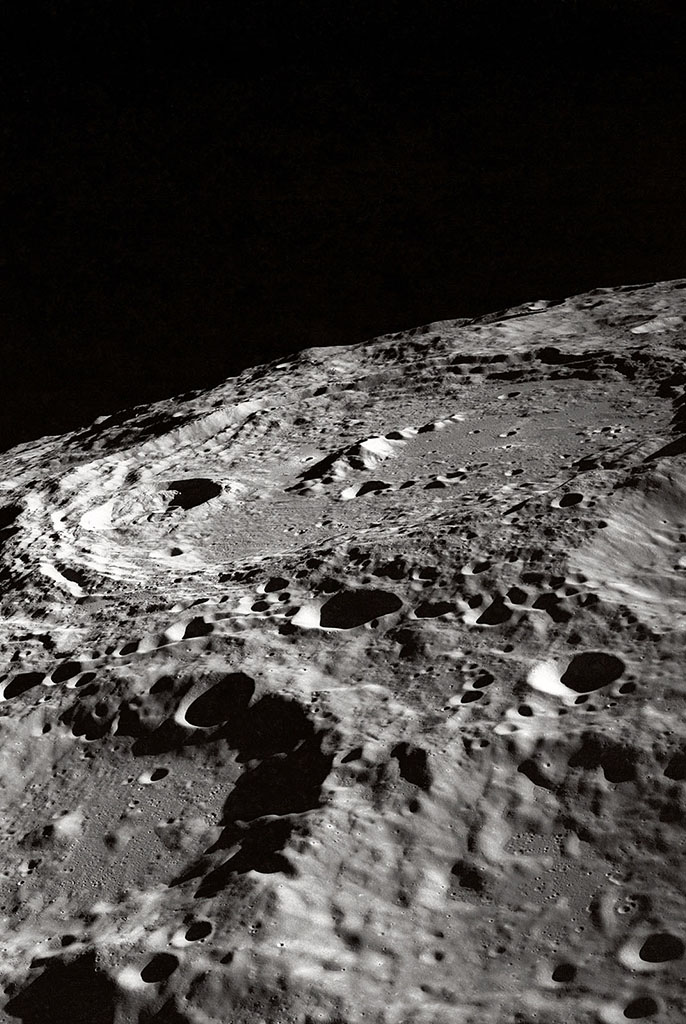
NASA is once again shooting for the Moon, for the first time since the 1970s. As soon as April 2026, NASA will launch its Artemis II mission, using the Space Launch System heavy lift rocket to send a crewed spacecraft, called Orion, into orbit. From there, the crew will journey to and circle around the Moon over 10 days.
In this episode of The Conversation Weekly podcast, we spoke to Scott Pace, the director of the Space Policy Institute at George Washington University. Pace worked with the George W. Bush administration in space policy, and from 2017 served for four years as the executive secretary of the National Space Council during Donald Trump’s first term as president.
In the first paragraph, it makes it sound like the spacecraft is landing on the moon. “From there, the crew to orbit around the Moon over 10 days”

The crew members of the Artemis II mission are, counterclockwise from left NASA astronauts Christina Hammock Koch, Reid Wiseman and Victor Glover and Canadian Space Agency astronaut Jeremy Hansen.
NASA
We’re about to send humans in orbit around the Moon again. What’s had to happen to get to this point?
Pace: Let’s go back to the 1980s and 1990s. After the space shuttle Challenger accident, a lot of people were thinking, “What do we do next?”
The space shuttle program was not an economic success. The recurring cost per flight was very expensive. So there was a lot of thinking about different vehicles that could be the shuttles’ successor. NASA pursued some of the higher-risk options, thinking that if they didn’t work out, they could still extend and use the shuttle. Some of those higher-risk ideas were things like single-stage-to-orbit space planes. When they didn’t work, it was OK because NASA was still working on the shuttle.
And then we had the 2003 space shuttle Columbia accident. NASA figured they could either stop for a decade or so and then try to restart a human spaceflight program once they had better technology, or try to transition the infrastructure and industrial base they had with the space shuttle to a new system.
When the second shuttle accident happened, we examined what we had to build a new system with, and we had solid rocket boosters and external tanks. To make something safer, we needed to build crew capsules. A capsule with an escape system onboard was one of the few immediate ways you could increase the likelihood of a crew’s survival.

If your eventual goal is Mars, you’ll then need a really heavy-lift vehicle to launch more crew and a heavier load. All that deliberation led to the current Space Launch System and the Orion capsule.
Four astronauts will be sent on a 10-day mission orbiting the Moon. What’s exciting to you about this mission, and what will you be looking out for?
Pace: The first thing is the performance of the solid rocket boosters on launch. Boosters are very reliable, but if they go bad, they go bad pretty…