

Scientists at St Andrews are leading a significant breakthrough in a decades-long challenge to develop compact laser technology. Lasers are...

An international research team has taken a decisive step toward a new generation of atomic clocks. At the European XFEL...
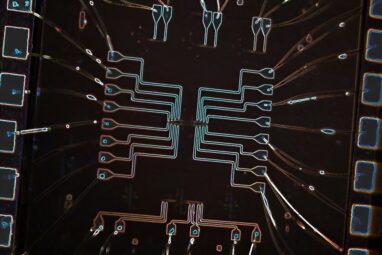
Today, we are living in the midst of a race to develop a quantum computer, one that could be used...
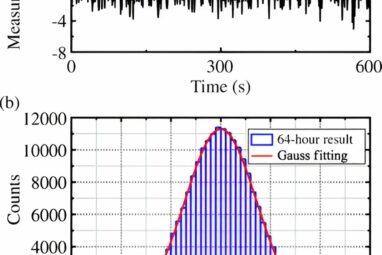
A team of researchers led by Academician DU Jiangfeng from the University of Science and Technology of China (USTC) of...
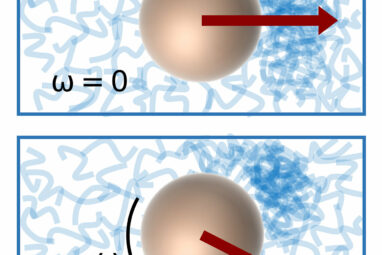
Whether you are familiar with the term “Magnus effect” or not, you have certainly seen it in action. It is...
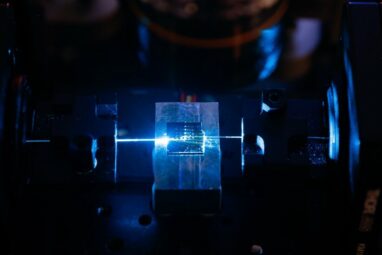
Researchers have created chip-based photonic resonators that operate in the ultraviolet (UV) and visible regions of the spectrum and exhibit...
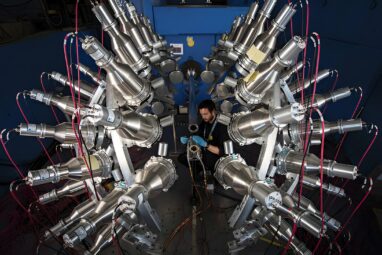
The results of the Chi-Nu physics experiment at Los Alamos National Laboratory have contributed essential, never-before-observed data for enhancing nuclear...
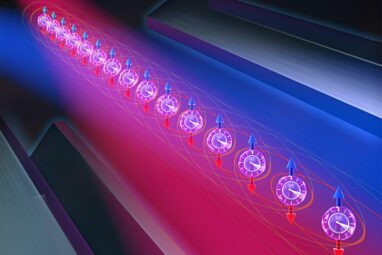
Opening new possibilities for quantum sensors, atomic clocks and tests of fundamental physics, JILA researchers have developed new ways of...
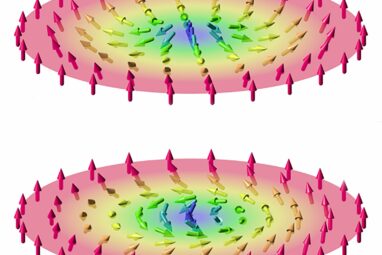
Imaging the elusive skyrmion: Neutron tomography reveals their shapes and dynamics in bulk materials
Scientists at the National Institute of Standards and Technology (NIST) with colleagues elsewhere have employed neutron imaging and a reconstruction...

In the future, quantum computers may be able to solve problems that are far too complex for today’s most powerful...
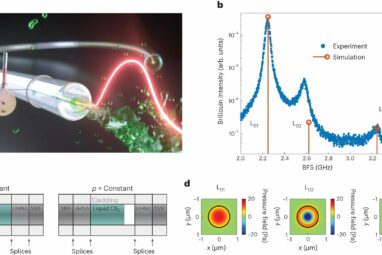
Negative pressure is a rare and challenging-to-detect phenomenon in physics. Using liquid-filled optical fibers and sound waves, researchers at the...
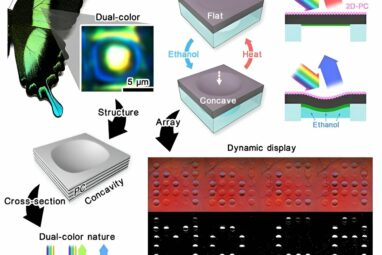
Researchers at the University of Hong Kong (HKU) have designed an innovative pixelated, soft, color-changing system called a Morphable Concavity...