

Mayonnaise continues to help researchers better understand the physics behind nuclear fusion. “We’re still working on the same problem, which...

Atoms are complex quantum systems consisting of a positively charged nucleus surrounded by negatively charged electrons. When multiple atoms come...
Today’s supercomputers consume vast amounts of energy, equivalent to the power usage of thousands of homes. In response, researchers are...

Although our universe may seem stable, having existed for a whopping 13.7 billion years, several experiments suggest that it is...

Full coherent control of wave transport and localization is a long-sought goal in wave physics research, which encompasses many different...

A new generation of specialty optical fibers has been developed by physicists at the University of Bath in the UK...

The early universe was 250,000 times hotter than the core of our sun. That’s far too hot to form the...
If net-positive fusion energy is to ever be achieved, density is key: the more atomic nuclei crashing into each other,...

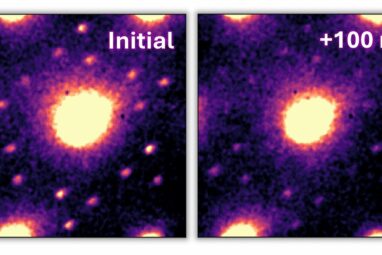
When the number of electrons matches host lattice sites in a material, strong interactions between electrons can cause them to...

Scientists cannot observe dark matter directly, so to “see” it, they look for signals that it has interacted with other...

Why does the universe contain matter and (virtually) no antimatter? The BASE international research collaboration at the European Organization for...

In a paper, titled “Partial coherence enhances parallelized photonic computing,” published in Nature, researchers from the University of Oxford, along...