
To think about an artificial limb is to think about a person. It’s an object of touch and motion made to be used, one that attaches to the body and interacts with its user’s world.
Historical artifacts of prosthetic limbs are far removed from this lived context. Their users are gone. They are damaged – deteriorated by time and exposure to the elements. They are motionless, kept on display or in museum storage.
Yet, such artifacts are rare direct sources into the lives of historical amputees. We focus on the tools amputees used in 16th- and 17th-century Europe. There are few records written from amputees’ perspectives at that time, and those that exist say little about what everyday life with a prosthesis was like.
Engineering offers historians new tools to examine physical evidence. This is particularly important for the study of early modern mechanical hands, a new kind of prosthetic technology that appeared at the turn of the 16th century. Most of the artifacts are of unknown provenance. Many work only partially and some not at all. Their practical functions remain a mystery.
But computer-aided design software can help scholars reconstruct the artifacts’ internal mechanisms. This, in turn, helps us understand how the objects once moved.
Even more exciting, 3D printing lets scholars create physical models. Rather than imagining how a Renaissance prosthesis worked, scholars can physically test one. It’s a form of investigation that opens new possibilities for exploring the development of prosthetic technology and user experience through the centuries. It creates a trail of breadcrumbs that can bring us closer to the everyday experiences of premodern amputees.
But what does this work, which brings together two very different fields, look like in action?
What follows is a glimpse into our experience of collaboration on a team of historians and engineers, told through the story of one week. Working together, we shared a model of a 16th-century prosthesis with the public and learned a lesson about humans and technology in the process.
A historian encounters a broken model
THE HISTORIAN: On a cloudy day in late March, I walked into the University of Alabama Birmingham’s Center for Teaching and Learning holding a weatherproof case and brimming with excitement. Nestled within the case’s foam inserts was a functioning 3D-printed model of a 500-year-old prosthetic hand.

Fifteen minutes later, it broke.
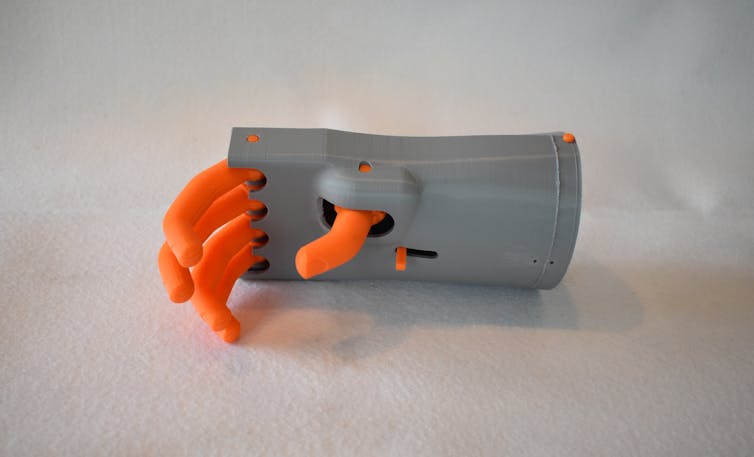
This 3D-printed model of a 16th-century hand prosthesis has working mechanisms.
Heidi Hausse, CC BY-SA
For two years, my team of historians and engineers at Auburn University had worked tirelessly to turn an idea – recreating the mechanisms of a 16th-century artifact from Germany – into reality. The original iron prosthesis, the Kassel Hand, is one of approximately 35 from Renaissance Europe known today.
As an early modern historian who studies these artifacts, I work…

