
You may be hearing a lot lately about critical minerals and rare earth elements. These natural materials are essential to industry and modern technology – everything from cellphones to fighter jets.
They include lithium and cobalt used in batteries, neodymium for magnets in motors and hard drives, and rare earths that are essential in defense systems, lasers and medical imaging. Critical minerals are also indispensable for renewable energy systems, energy storage and digital infrastructure. Without them, modern society – and any realistic path to a world with net-zero emissions – would not be possible.
Critical minerals get their name because they’re also highly vulnerable to supply chain disruptions from global events, trade tensions or economic instability. And, today, one country dominates many critical mineral supply chains: China.
With that in mind, many governments are looking for alternative sources of critical minerals, and several companies are eyeing the ocean floor as a potential new frontier for mining them.
A map shows seafloor areas being considered for exploration and critical minerals mining. International Seabed Authority
As a marine geologist, I know the potential for seafloor minerals is vast. But that doesn’t mean those minerals are easy to harvest. They come in several forms, from potato-size rocks scattered on the seafloor to seafloor crusts at hydrothermal vents and underwater brine pools. And they are often found in sensitive locations that are home to fragile marine life, raising questions about damage to some of the least explored and least understood parts of our planet.
Polymetallic nodules on the seafloor
When you picture seafloor mining, polymetallic or manganese nodules are probably what come to mind.
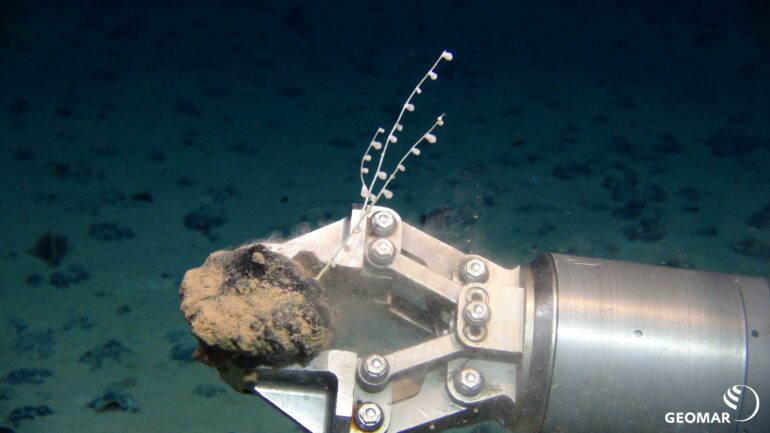
Rock-like nodules are about the size of potatoes and are found scattered on vast deep-water plains, typically 3,000 to 6,000 meters deep, in several regions, including a large area of the Pacific Ocean southeast of Hawaii.
They primarily consist of manganese and iron, though they can contain significant amounts of other metals, including valuable nickel, cobalt, copper and small amounts of rare earth elements and platinum.


Polymetallic nodules spotted during a survey of the Blake Plateau, roughly 80 to 200 miles off the southeastern U.S. coast in the Atlantic Ocean.
NOAA Office of Ocean Exploration and Research, 2019 Southeastern U.S. Deep-sea Exploration
Nodules form from metals that get into the ocean through erosion or from seafloor hydrothermal vents in volcanically active areas. The metal ions attach to a nucleus, such as a rock or shell fragment. Over time, layers form around that core. The growth is very slow – only a few millimeters in a million years – so larger nodules can be several million years old.
More than 17 exploration licenses exist, primarily in the…

