Finding life beyond the Earth would be a major scientific discovery with significant implications for all areas of science and human thought. Yet, only one direct search for extraterrestrial life has ever been conducted.
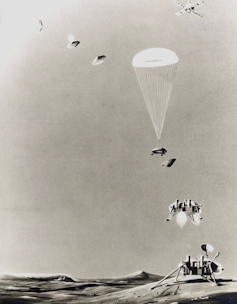
The Viking missions landed on the Martian surface using parachutes. This diagram shows each stage the spacecraft went through as they landed.
NASA
The NASA Viking spacecraft, which landed on Mars, conducted this search in the summer of 1976. Viking consisted of two twin orbiters and landers, with experimental chambers in the landers to conduct three biology experiments.
Over the past half-century, the measurements made during the Viking biology experiments have been the subject of many discussions, analyses and speculation. Today, scientists are still discussing the results of these experiments in an attempt to answer the age-old question of whether there is life beyond the Earth.
The year 2025 marks 50 years since the two spacecraft launched, three weeks apart. These landers achieved humankind’s first two successful soft landings of operational and functioning spacecraft on the surface of another planet.
I’m an atmospheric scientist who worked on the Viking missions in the 1970s at the NASA Langley Research Center, the laboratory that developed and managed the highly successful Viking missions. The Viking missions’ scientific discoveries painted a new picture of Mars’ atmosphere, surface and planetary history.
The Viking 1 lander reached the surface of Mars after being ejected from a spacecraft and deploying a parachute.
Launching and landing the Viking spacecraft
The two Viking spacecraft both consisted of an orbiter and a lander. Viking 1 entered Mars’ orbit on June 19, 1976, and successfully landed on the surface on July 20, 1976, which was also the seventh anniversary of the first human Moon landing. Viking 2 followed, landing on Sept. 3, 1976, at a site farther to the northwest.
Viking wasn’t just looking for life.
These crafts contained equipment to take pictures; map heat energy, wind and weather; study the chemical composition of the surface, dust and atmosphere; and collect and analyze soil samples.

Measurements that Viking took of the atmosphere suggested that Mars used to have a much denser atmosphere but over time lost it. It also observed that the wind picks up tiny dust particles, blowing them into the atmosphere. This process colors the planet’s sky permanently pink.
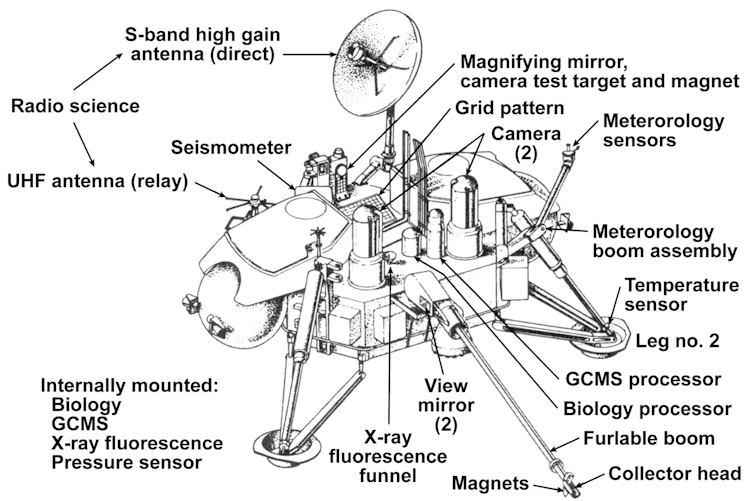
All the instruments found on the Viking landers.
NASA
The Viking landers also discovered that at any location on Mars, the atmosphere’s surface pressure varies seasonally. The planet has frozen north and south poles, like on Earth. At the Martian poles in summer, the frozen carbon dioxide sublimates – transforming from a frozen solid to a gas – and then at the…