
When you lift weights, walk up a steep hill or ride a bike, your body is continuously sending sensory signals to your brain. These signals paint a picture of the physical sensation of what you’re doing. Your brain then takes these signals and filters them through your past experience, goals, expectations and current emotional state.
It turns out that the way your brain uses all that context to interpret this sensory information significantly influences whether you perceive something physically strenuous, such as a bike ride, as difficult and threatening or as rewarding and pleasant.
Many people who are new to exercise often quit because they interpret physical discomfort as a warning sign instead of a challenge that can be overcome. But in recent years, scientists have shown that by changing your emotional state, you can also change how you interpret physical sensations.
We are two neuroscientists who study how the brain and body respond to stress and how those reactions shape perception. Research has shown that small, well-timed challenges can help the body and mind grow more resilient, while too much stress, or stress at the wrong time, can slow recovery and sap motivation.
In a recent experiment, we wanted to see whether it is possible, in a sense, to recalibrate how the brain interprets difficult tasks using a tiny, safe dose of physical discomfort. We found that physical stress in manageable doses – in this case, dunking your hand in ice-cold water – can make a later effort feel more doable, particularly for people who are not yet accustomed to strenuous exercise.
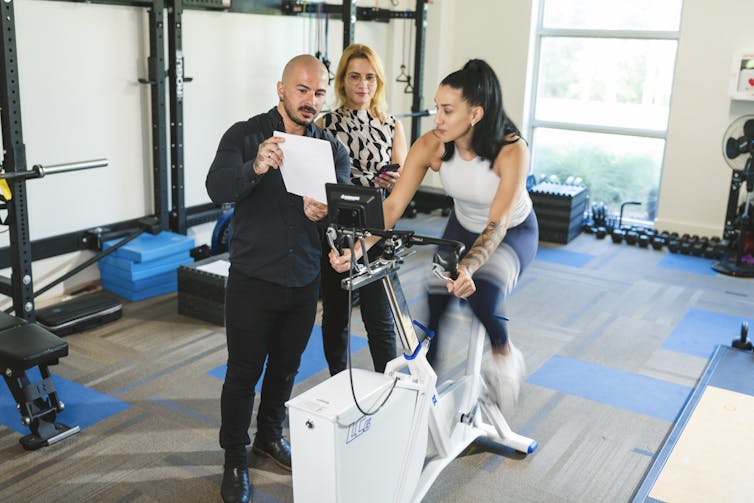
Authors Marcelo Bigliassi and Dayanne S. Antonio monitor psychophysiological and psychological data while a participant performs a cycling exercise on a stationary ergometer.
Margi Rentis
Cold first, bike second
In order to evaluate the concept of stress calibration, we assembled a group of 31 adult volunteers with limited prior engagement in physical activity. Our physical fitness task involved volunteers riding a stationary bike for six minutes, with the effort increasing in short stages from easy to tough.
On one visit, before getting on the bike, participants put one hand into a bucket of ice-cold water and kept it there for as long as they could – between one and three minutes. We hypothesized this physical stress would trigger a slight change in how their brains would interpret physical sensations and change their ability to tolerate physical discomfort; this was the recalibration step.

On the other visit they just got on the bike without doing a cold-water hand dunk. To help control for variables, we mixed up the order so that some people did the cold-water dunk on the first day and others did it on the second.
While riding the test bike, participants reported on a number of variables using rating scales, including how much pain they felt, how pleasant or unpleasant the effort seemed, how much energy they had,…