

Russian President Vladimir Putin, dressed in a military uniform, announced on Oct. 26, 2025, that Russia had successfully tested a nuclear-powered missile. If true, such a weapon could provide Russia with a unique military capability that also has broader political implications.
The missile, called Burevestnik, was reportedly successfully tested over the Arctic Ocean after years of development and several earlier initial test flights, one of which resulted in the deaths of five nuclear scientists.
I am an engineer who studies defense systems. Here is how these weapons function, the advantages they present over conventional missile systems, and their potential to disrupt global strategic stability.
Conventionally powered missiles
Missiles have been used by militaries around the world for centuries and come in a broad array of designs that are characterized by their mission, range and velocity. They are used to damage and destroy a wide variety of targets, including ground installations such as bases, command centers and deeply buried infrastructure; ships; aircraft; and potentially spacecraft. These weapons are operated from the ground by the army, from the sea by navy ships, and from the air by fighters and bombers.
Missiles can be tactical, with relatively short ranges of less than 500 miles, or strategic, with long ranges of thousands of miles. Missiles fall into three general categories: ballistic, cruise and hypersonic.
Ballistic missiles are launched on rockets. After the rocket burns out, the missile flies along a predictable arc that takes it out of the atmosphere into space and then back into the atmosphere toward its target.
Cruise missiles have an additional engine that is ignited after the rocket burns out, allowing the missile to fly programmed routes, typically at low altitudes. These engines are powered by a mixture of chemicals or a solid fuel.
Hypersonic missiles fly faster than the speed of sound, but not as fast as intercontinental ballistic missiles, or ICBMs. They are launched on smaller rockets that keep them within the upper reaches of the atmosphere. A hypersonic glide vehicle is boosted to high altitude and then glides to its target, maneuvering along the way. A hypersonic cruise missile is boosted to hypersonic speed and then uses an air-breathing engine called a scramjet to sustain that speed.
How nuclear-powered missiles work
Nuclear-powered missiles are a type of cruise missile. The designs are typically a form of scramjet. A thermal nuclear system uses fission of nuclear fuel to add energy to an airstream that is then accelerated through a nozzle to generate thrust. In this way, fission of nuclear material replaces chemical combustion of traditional cruise missile engines.
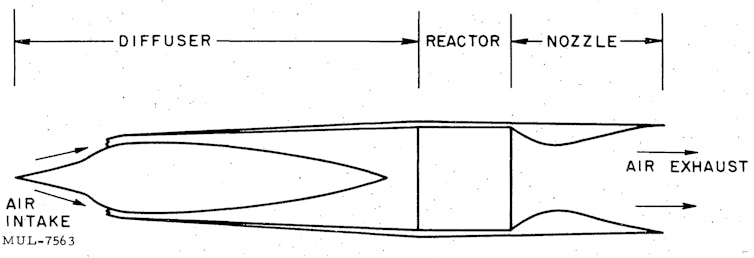
The concept for a nuclear-powered scramjet is simple, even if building one is extremely challenging.
Lawrence Berkeley National Laboratory
The energy density – the amount of energy…

