
Curious Kids is a series for children of all ages. If you have a question you’d like an expert to answer, send it to [email protected].
Are there thunderstorms on Mars? – Cade, age 7, Houston, Texas
Mars is a very dry planet with very little water in its atmosphere and hardly any clouds, so you might not expect it to have storms. Yet, there is lightning and thunder on Mars – although not with rain, nor with the same gusto as weather on Earth.
More than 10 years ago, my planetary science colleagues and I found the first evidence for lightning strikes on Mars. In the following decade, other researchers have continued to study what lightning might be like on the red planet. In November 2025, a Mars rover first captured the spectacular sounds of lightning sparking on the Martian surface.

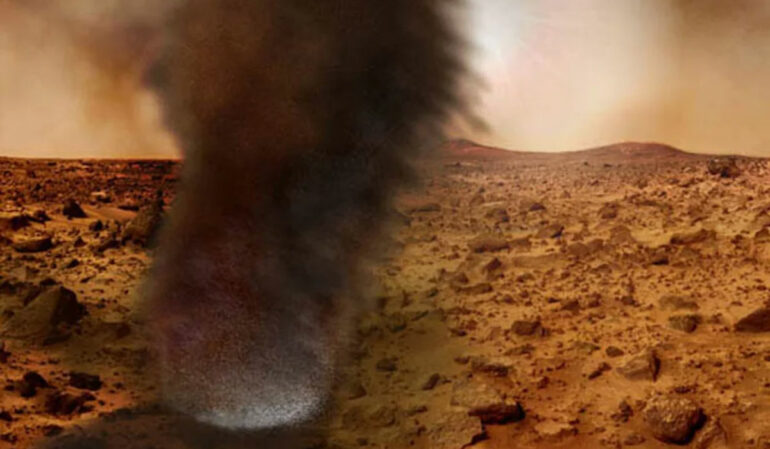
Mars dust storms are many times larger and taller than this large terrestrial dust devil photographed in a valley near Las Vegas.
Fernando Saca, University of Michigan
Lightning on Mars
On Earth, lightning is an electric discharge that begins inside big clouds.
But because Mars is so dry, it doesn’t have clouds of water – instead, it has clouds of dust. With little water to weigh down dirt on Mars, dust clouds can quickly grow into huge, windy dust storms a few times taller than Earth’s tallest thunderstorms.
When smaller dust particles and larger sand particles collide with each other while being whipped around by these storms, they pick up a static charge. Smaller dust particles take on a positive charge, while larger sand particles become negative. The smaller dust particles are lighter and will float higher, while the heavier sand tends to fall closer to the ground.
Because oppositely charged particles don’t like to be apart, eventually the energy building between the negative charges higher up in the dust storm and the positive charges closer to the ground becomes too great and is released as electricity – similar to lightning.

The air around the electricity rapidly warms up and expands – on Earth, this creates the shock waves that you hear as thunder.
Nobody has seen a flash of lightning on Mars, but we suspect it’s more like the glow from a neon light rather than a powerful lightning bolt. The atmosphere near the surface of Mars is about 100 times less dense than on Earth: It’s much more similar to the air inside neon lights.

The dust devil shown creates a dark track as it lifts the small and brighter dust particles.
Mars Global Surveyor/NASA/JPL/Malin Space Science Systems
Releasing radio waves
Besides shock waves and visible light, lightning also produces other types of waves that the human eye can’t see: X-ray and radio waves. The ground and the top of the atmosphere both conduct electricity well, so they guide these radio waves and cause them to produce signals with…