With the launch of NASA’s Artemis II mission on April 1, 2026, human beings have finally returned to the Moon for the first time in 50 years – since the age of Apollo.
When Apollo 11 first landed on the lunar surface, the astronauts portrayed their accomplishment as the realization of a science fictional dream. In a televised broadcast during their return, Neil Armstrong explicitly evoked Jules Verne’s 1865 novel “From the Earth to the Moon,” calling his spaceship and crew a “modern-day Columbia” – a direct reference to the spaceship Verne imagined taking off in from Florida and landing in the Pacific Ocean.
Discourse around science fiction coming true often focuses on the gadgets and technologies it predicted. But as sci-fi author Frederik Pohl reputedly said, it’s not about imagining the car, but the traffic jam.
As a literature professor who has studied science fiction for a decade and editor of a forthcoming edition of Verne’s novel annotated for the spacefaring age, I find that what makes Verne’s 1865 novel prescient is that a century before the Moon landing, he understood that a moonshot would not be an act of pure and abstract science. It would exist within a political, social and economic context.

‘From the Earth to the Moon’ by Jules Verne describes a fictional Moon mission and its political, economic and environmental ramifications.
Patrice Cartier/Hans Lucas/AFP via Getty Images
In his novel, the moonshot is proposed by the Baltimore Gun Club in the months after the U.S. Civil War, and Verne tells the story of how they make this colossal undertaking happen. Writing before even the age of powered flight, he foresaw that a project to send a small handful of carefully selected, exceptional individuals beyond Earth would have ripple effects throughout the entire world.
And with four astronauts having just circled the Moon as part of the Artemis II mission, the similarities between Verne’s vision and America’s current Moon-oriented dreams are striking – and revealing of the realities of the spacefaring age.
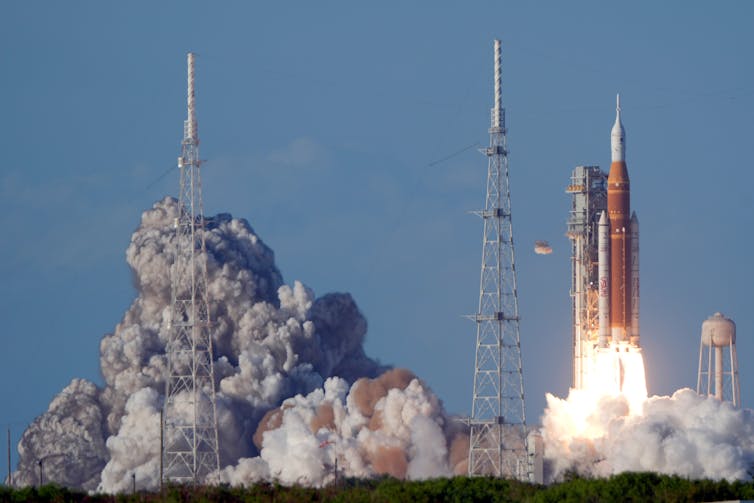
NASA’s Artemis II crew lifts off from the Kennedy Space Center’s Launch Pad 39-B on April 1, 2026.
AP Photo/John Raoux
A nationalist and international project
In Verne’s novel, the moonshot is explicitly proposed as a nationalist project, even as it also becomes a pinnacle of human achievement that unifies the world. The speech in which it is proposed is one full of celebrations of American engineers, scientists and generals who have come before, and Americanness is key to its realization.
At one moment, it becomes clear that the launch must occur near the equator to minimize the distance to the Moon. Since this is an American endeavor, however, the protagonists are adamant that it must launch from the United States, and the Gun Club briefly considers invading Mexico to make this happen before…