When learning about the effects of spaceflight on human health, you typically will hear about the dangers of radiation, bone density loss and changes in eyesight. While these long-term risks are important, a less frequently discussed concern is motion sickness.
As a child, one of us (Taylor) was highly prone to motion sickness – whether in the backseat of a car, sitting on a train or riding a bus. At the time, she considered it a cruel twist of fate, but as an adult – and a scientist to boot – Taylor can tell you with confidence that it was entirely her fault.
You see, like most children during long car rides, Taylor would get bored. So, to combat this boredom, she would either read a book or play on her Gameboy. She would stare down at whatever form of entertainment was in her lap that day until the familiar creeping sensation of nausea developed.
Sometimes, looking out the side window would help, but more often than not, Taylor’s dad would have to pull over at the next gas station for a short break, or else they’d all suffer the consequences.
Now, she understands what was happening on a more fundamental level. As children, you are taught about the five senses: sight, hearing, smell, taste and touch. However, there is a hidden sixth sense that helps your body understand how you are moving – the vestibular system. The brain takes information from all these senses and compares it to what it might expect when moving, based on past experiences.
Optimally, any disagreement between your vestibular senses and your brain’s expectations would be small. But when there are large, sustained conflicts, you get sick.
While reading in the car, Taylor was staring at nonmoving words on a page while her vestibular system told her brain she was traveling down a road. This discrepancy confused her brain since usually, when Taylor felt movement, she should see the world shifting around her in the same way – hence her motion sickness. Had she been looking out the window and watching the world pass by, she would have been fine. Even better, had she been in the front seat, she would have been able to see the road ahead and predict how she would move in the future.
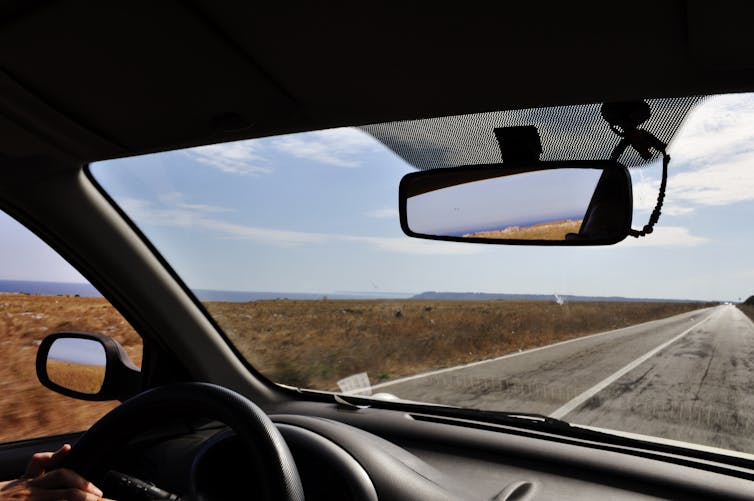

Looking out the front window while driving can help mitigate motion sickness by aligning your vestigial senses with how your brain expects to be moving.
EyeEm Mobile GmbH/iStock via Getty Images
The sensory conflict between what you experience and what your brain expects doesn’t cause only carsickness. It is also the leading suspect behind cybersickness from using virtual reality headsets, seasickness on ships and spaceflight-driven motion sickness. Our team of aerospace engineers is particularly interested in the latter.
Motion sickness during spaceflight
To date, all astronauts have grown up on Earth. So, their brains expect any motion cues to include the presence of Earth’s gravity. But when they get to orbit in space, that is no…