
![How To Plan A Coaching Session [Part 2]](https://techandsciencepost.com/wp-content/uploads/2025/07/creating-make-believe-teammates-competitors-and-coaches-during-play-770x513.jpg)
The coach, the specialized equipment, the carefully tailored exercise regimen – they’re all key to athletic performance. But imagination might be an unexpected asset when it comes to playing sports.
The idea that athletic achievement depends on the mind isn’t new. Sport psychologists have known for years that working with an athlete on their mental game – visualizing the skill, kinesthetically feeling the swing – has a positive impact on actual performance. But these mental simulations draw only upon mental imagery – seeing and feeling the physical goals in the mind’s eye. Imagination offers a much wider range of possibilities.
What if your game could be helped by an imaginary friend?
In a recent retrospective study of college students, we discovered that imagination comes in handy in athletics in ways that are surprisingly social. The creation of what we termed imaginary athletes – a person or being that a child imagined in the context of athletics – enabled and motivated athletic play, especially for children between the ages of about 6 and 12. Imaginary athletes also provided companionship during athletic play.
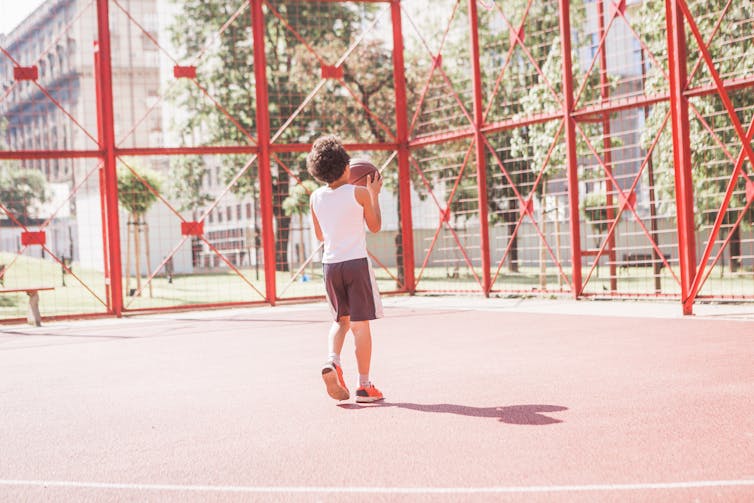
An imaginary teammate or competitor might help improve a child’s game.
NoSystem images/E+ via Getty Images
Remembering childhood imaginary athletes
The most basic form of an imaginary athlete might be a wall, fence or even tree that makes a good opponent in a pinch. For a child or adolescent practicing a sport alone, a surface that provides a ball return or a steady target for a throw gives opportunities for practice usually requiring other players.
Is it any wonder, then, if the branches of the tree start to resemble a wide receiver’s arms, or an invisible goalie emerges in front of the fence? Solitary play might be a lot more fun if a make-believe teammate could provide an assist, or an invisible coach could appear and shout instructions during practice.
The college students in our study reported that such support, even if imaginary, made them play a little longer or try a little harder as kids.
About 41% of our sample of 225 college students reported creating at least one imaginary athlete at some point in middle childhood or early adolescence. Most, but not all, of these beings fell into three categories based on their characteristics.

The first we called placeholders, such as ghost runners. They are typically generic, amorphous, imaginary teammates created by groups of children when not enough real players are available.
The second type functioned as what we named athletic tools. They helped kids focus on their performance and improve their skills, usually by providing a worthy competitor, sometimes based on an admired professional athlete. The skills of athletic tools were often just above those of the child, drawing out the desire to be better, stronger, faster.
Social relationships, our name for the third kind of imaginary athlete, primarily…