
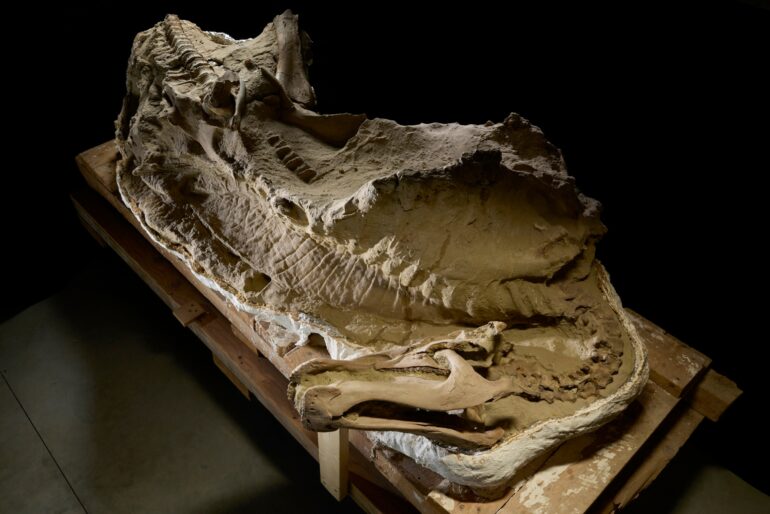
Dinosaur “mummies” couldn’t have been further from my mind as I trudged up a grassy knoll on the Zerbst Ranch in east-central Wyoming, followed by University of Chicago undergraduates on a field trip linked to my “Dinosaur Science” course.
As a university professor, I realized early that to understand paleontology, students would need to see first-hand where fossils are born. And that field experience had to be real, a place I wanted to be – somewhere where we had a shot at discovery.
I chose outcrops of the Lance Formation, a rock formation composed largely of sandstones laid down during last few million years of the dinosaur era. These rocks are well exposed in the parched badlands of Wyoming, crisscrossed for more than a century by dinosaur hunters. Yet, perhaps they missed something.
Then I saw it.
At the top of the hill lay a massive concretion – a hardened, iron-stained rock the size of a compact car – surrounded by some fossil bone fragments. Poking from its side were a series of small rod-shaped bones I recognized as the stomach ribs of the giant predator Tyrannosaurus rex.
Mummies nearby
But T. rex wasn’t alone among the amazing finds that field season. That same field trip, colleagues working nearby uncovered two fossilized duckbills – a plant-eating dinosaur that roamed in herds and grew to the length of T. rex. They showed signs of extraordinary preservation.
Poking out of the vertical wall of a cutbank in a seasonally dry river was a vertebra – part of the backbone – and some ossified tendons.
“What do you think?” asked my colleague Marcus Eriksen, who counts paleoartistry, science education and environmentalism as his other mainstays alongside paleontology. “You’ve got the back half of a duckbill,” I said, referring to Edmontosaurus annectens, the formal name for the dinosaur most likely to be on T. rex’s dinner menu.
It would take Marcus two field seasons to remove 15 feet of rock overlying the skeleton. To his surprise, the tail bones were covered with large areas of scaly skin and topped by a row of spikes. When I visited the exposed skeleton and took a look at its feet, I saw a hairline around the final toe bone. “Pull back, take more,” I said, wide-eyed at what I saw. “I think it has the hooves.”
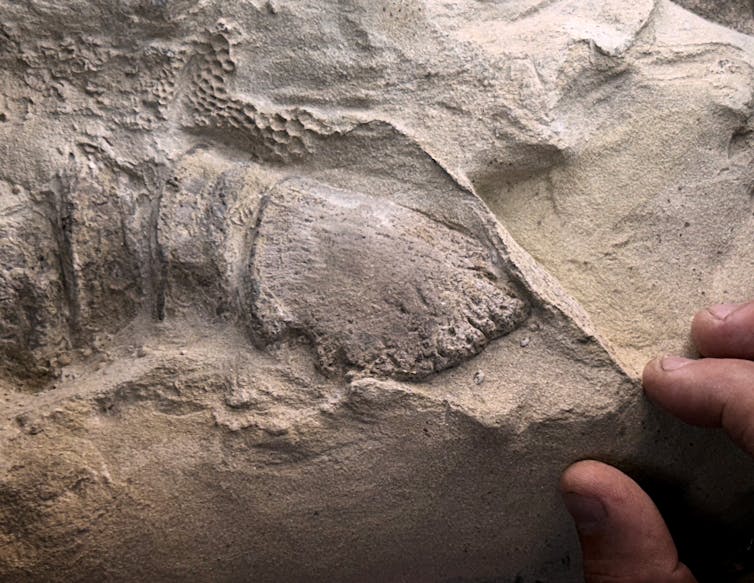

A juvenile duckbill dinosaur’s hoof preserved as a thin layer of clay.
Tyler Keillor/Fossil Lab
Yet another group of bone hunters in the area found a Triceratops skeleton next to a large slab of its scaly skin. Finding even a patch of skin on a skeleton merits celebration in paleontological circles. Discovering large areas of the outer fleshy surface of a dinosaur is the find of a lifetime.
Mummification mystery
How is the skin of a dinosaur “mummy” preserved? What composes the “skin impressions”?
Are these dinosaur “mummies” preserved like the human mummies from Egypt, where salt and oils applied after someone died…

