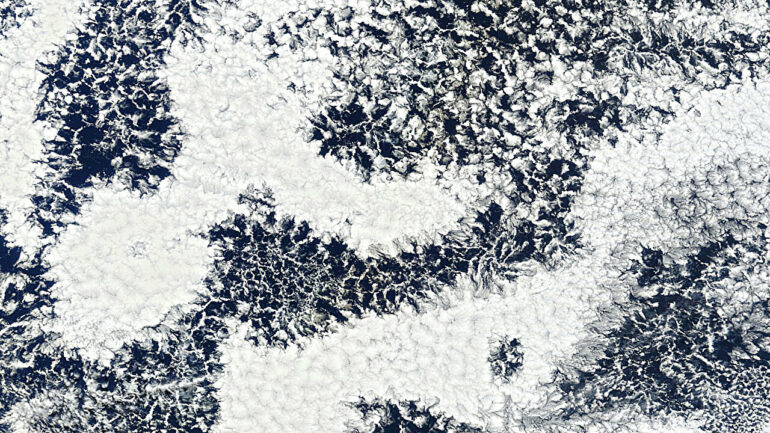
The way clusters of differently sized water droplet populations are distributed within clouds affects larger-scale cloud properties, such as how light is scattered and how quickly precipitation forms. Studying and simulating cloud droplet microphysical structure is difficult. But recent field observations have provided crucial, centimeter-scale data on cloud droplet size distributions in stratocumulus clouds, giving researchers an opportunity to better match their models to reality.
The simulations of characteristic droplet size distributions that those models are providing are likely too uniform, say Nithin Allwayin and colleagues. This muddled microphysical structure could be leading cloud simulations, and the climate models that use them, astray. Their paper is published in the journal Geophysical Research Letters.
The authors compare the new observed data on cloud microphysical structure with results from large-eddy simulations (LES) of stratocumulus clouds. At convective scales, the model showed intriguing correlations between droplet cluster characteristics and overall cloud physics. For example, regions of the clouds dominated by drizzle tended to have larger drops but not necessarily more total water content, and the updraft regions of clouds tended to have smaller drops and a narrower distribution of droplet size.
However, across larger spatial scales, the characteristic droplet size distributions in the model looked very similar across different parts of a cloud. This diverges sharply from the observations, which show that the size distributions vary across large-eddy scales within the cloud.
One explanation could be that the process of entrainment—in which drier air is introduced into a cloud and causes evaporation—is not well resolved in these models, the authors say, noting a relationship between observations of characteristic droplet size distributions and local entrainment rates. In addition, models often assume that boundary layer properties such as surface fluxes and aerosol types are uniform across clouds.
The authors argue that a better understanding of cloud microphysics and its link to entrainment and boundary fluxes is needed to advance atmospheric modeling. The LES runs in this study are idealized cases, the researchers add, which should be kept in mind when interpreting their results. Future work should focus on understanding the role of horizontal gradients in aerosol concentrations, as well as on improving model entrainment layers, the authors suggest. Lagrangian schemes in LES models could hold more promise for this work.
More information:
Nithin Allwayin et al, Investigating Characteristic Droplet Size Distributions in Large Eddy Simulations of Stratocumulus Clouds, Geophysical Research Letters (2025). DOI: 10.1029/2025gl116021
Provided by
American Geophysical Union

This story is republished courtesy of Eos, hosted by the American Geophysical Union. Read the original story here.
Citation:
Cloud droplet microphysics challenges accuracy of current climate models (2025, November 10)