
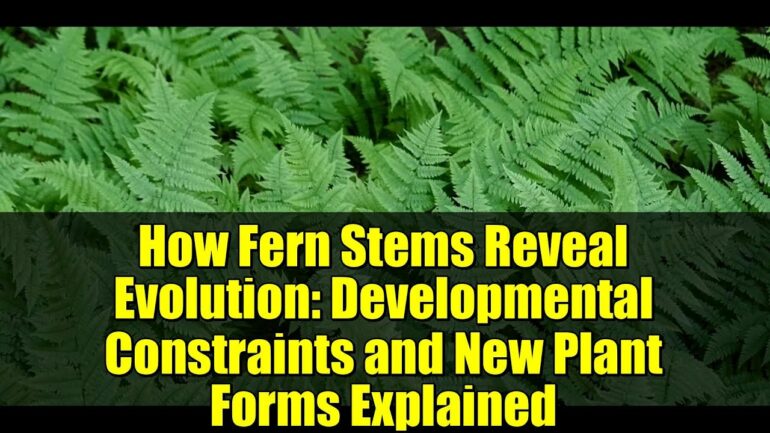
There are few forms of the botanical world as readily identifiable as fern leaves. These often large, lacy fronds lend themselves nicely to watercolor paintings and tricep tattoos alike. Thoreau said it best: “Nature made ferns for pure leaves, to show what she could do in that line.”
But ferns are not just for art and gardens. While fern leaves are the most iconic part of their body, these plants are whole organisms, with stems and roots that are often underground or creeping along the soil surface. With over 400 million years of evolutionary history, ferns can teach us a lot about how the diversity of planet Earth came to be. Specifically, examining their inner anatomy can reveal some of the intricacies of evolution.
Sums of parts or an integrated whole?
When one structure cannot change without altering the other, researchers consider them constrained by each other. In biology, this linkage between traits is called a developmental constraint. It explains the limits of what possible forms organisms can take. For instance, why there aren’t square trees or mammals with wheels.
However, constraint does not always limit form. In my recently published research, I examined the fern vascular system to highlight how changes in one part of the organism can lead to changes in another, which can generate new forms.
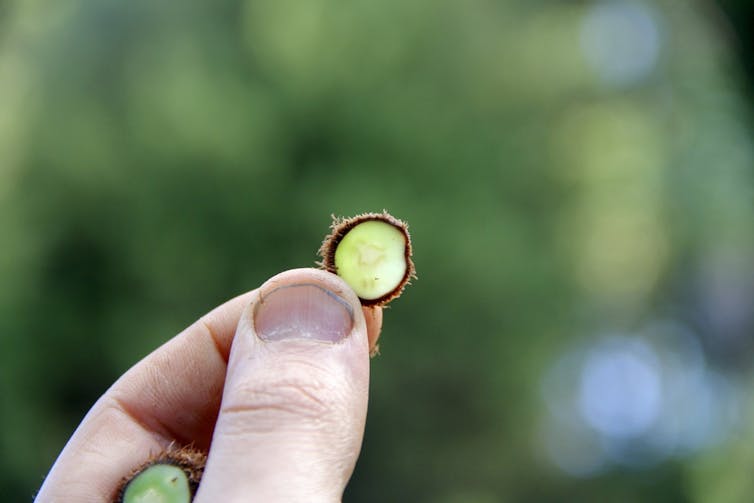
Cross section of a stem of Adiantum in Costa Rica. If you zoom in, you can make out the radial arrangement of bundles in the stem – the darker dots in the circle at its center.
Jacob S. Suissa, CC BY-ND
Before Charles Darwin proposed his theory of evolution by natural selection, many scientists believed in creationism – the idea that all living things were created by a god. Among these believers was the 19th-century naturalist Georges Cuvier, who is lauded as the father of paleontology. His argument against evolution was not exclusively based in faith but on a theory he called the correlation of parts.
Cuvier proposed that because each part of an organism is developmentally linked to every other part, changes in one part would result in changes to another. With this theory, he argued that a single tooth or bone could be used to reconstruct an entire organism.
He used this theory to make a larger claim: If organisms are truly integrated wholes and not merely sums of individual parts, how could evolution fashion specific traits? Since changes in one part of an organism would necessitate changes in others, he argued, small modifications would require restructuring every other part. If the individual parts of an organism are all fully integrated, evolution of particular traits could not proceed.
However, not all of the parts of an organism are tethered together so tightly. Indeed, some parts can evolve at different rates and under different selection pressures. This idea was solidified as the concept of quasi-independence in the 1970s by evolutionary biologist Richard Lewontin….

