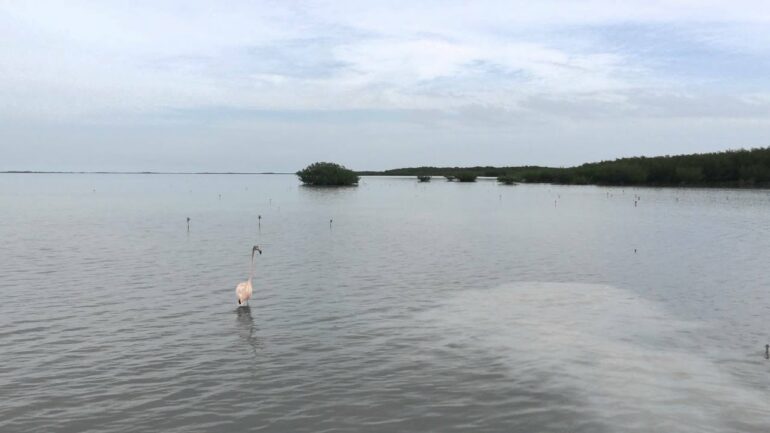
Hurricane Idalia blew a flamboyance, or flock, of 300-400 flamingos that was likely migrating between the Yucatan Peninsula and Cuba off course in August 2023 and unceremoniously deposited the birds across a wide swath of the eastern United States, from Florida’s Gulf Coast all the way up to Wisconsin and east to Pennsylvania.
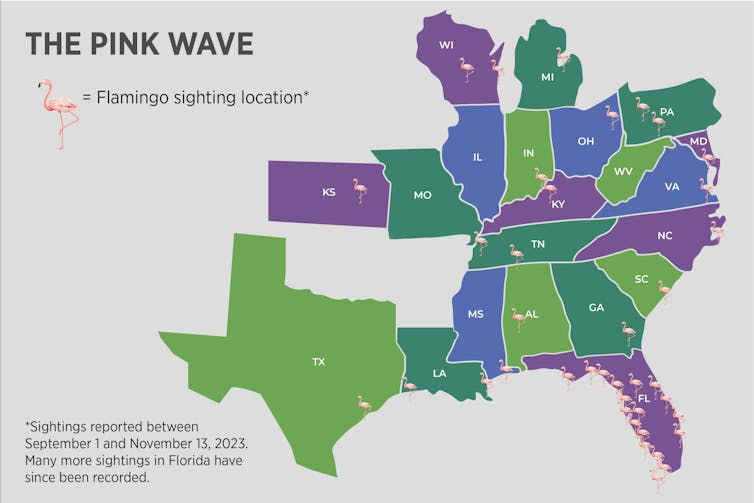
After Hurricane Idalia, more than 300 credible sightings of flamingos across the eastern U.S. were reported.
Audubon Florida
I’m an estuarine scientist. That means I study ecosystems where fresh water flows into the ocean. I’ve spent 35 years with Audubon Florida studying the ecology of American flamingos and other wading birds in Florida Bay, Everglades National Park. So naturally, I was thrilled and intrigued by the sudden arrival of these flamingos.
One of the birds was rescued in the Tampa area after nearly drowning in the Gulf of Mexico. His rescuers named him Peaches.
A colleague and I were able to place a GPS tracking device and a bright blue band around his spindly leg, with the code “US02” engraved in white letters.
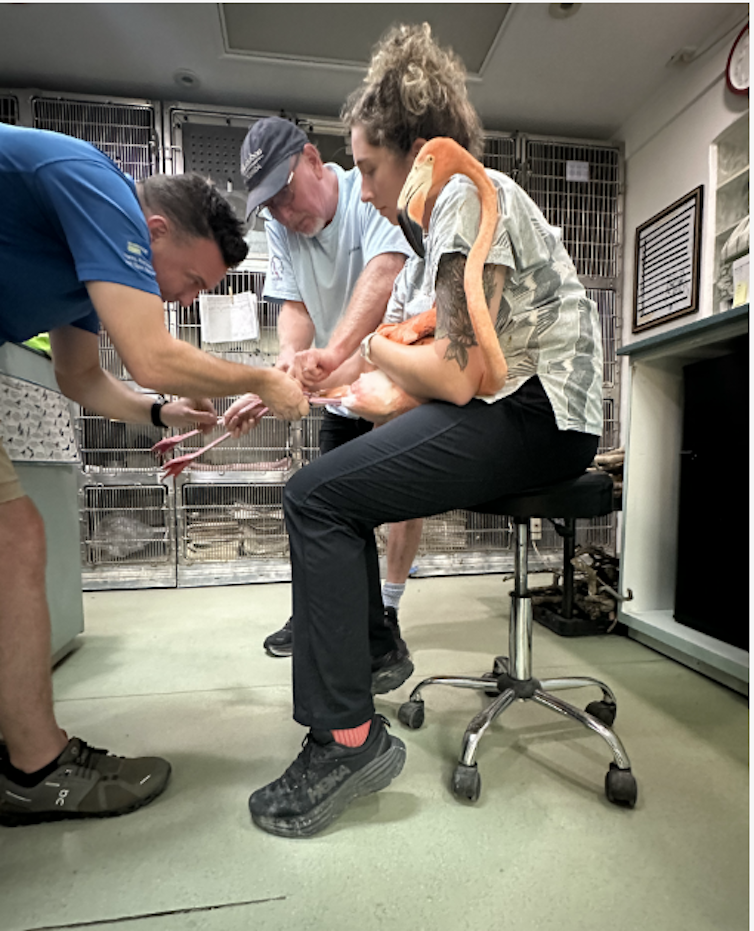
Melissa Edwards, Avian Hospital Director at Seaside Seabird Sanctuary, holds Peaches still while Dr. Frank Ridgley of Zoo Miami and the author, Dr. Jerome Lorenz, place a band and GPS tracker on his leg. Dr. Lorenz has banded or supervised the banding of nearly 3,000 roseate spoonbills, but Peaches was his first and only flamingo to date.
Linda Lorenz
We were hoping to track his movements and see whether he ended up settling in Florida. Unfortunately, a few days after Peaches was released back into the wilds of Tampa Bay, the tracking device failed. His last reported sighting was on a beach near Marco Island on Oct. 5, 2023.
Then, in June 2025, I received an email from colleagues at the Rio Lagartos Biosphere Reserve in Yucatan, Mexico, who had photographed Peaches, blue band still in place, nesting in the reserve.
Peaches’ story is the latest piece in the historical puzzle of flamingos in Florida. Though the native population disappeared more than 100 years ago, recent events lead me to believe that flamingos may be coming back to the Sunshine State, and that their return has been facilitated by the concerted effort to restore the Everglades and coastal ecosystems.

Decimation of a population
In 1956, ornithologist and founder of the National Audubon’s Everglades Science Center Robert Porter Allen wrote “The Flamingos: Their Life History and Survival,” which is still considered a seminal document on the history of flamingos in Florida.
In his book, Allen cites several historical and scientific manuscripts from the 1800s that indicate flamboyances of hundreds to thousands were seen in the Everglades, Florida Bay and the Florida Keys.
Allen documents the demise of flamingos in the late 1800s, in Florida and throughout their Caribbean and Bahamian range. Like all wading birds in Florida, they…