
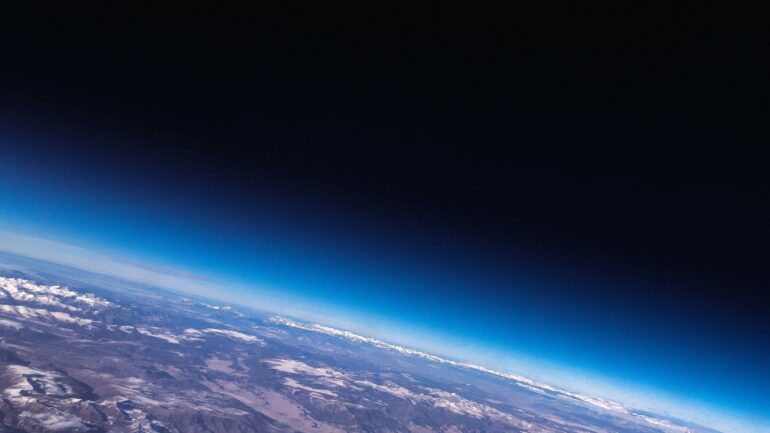
There are about 15,000 satellites orbiting the Earth. Most of them, like the International Space Station and the Hubble Telescope, reside in low Earth orbit, or LEO, which tops out at about 1,200 miles (2,000 kilometers) above the Earth’s surface.
But as more and more satellites are launched into LEO – SpaceX’s Starlink internet constellation alone will eventually send many thousands more there – the region’s getting a bit crowded.
Which is why it’s fortunate there’s another orbit, even closer to Earth, that promises to help alleviate the crowding. It’s called VLEO, or very low Earth orbit, and is only 60 to 250 miles (100 to 400 kilometers) above the Earth’s surface.
As an engineer and professor who is developing technologies to extend the human presence beyond Earth, I can tell you that satellites in very low Earth orbit, or VLEO, offer advantages over higher altitude satellites. Among other benefits, VLEO satellites can provide higher-resolution images, faster communications and better atmospheric science. Full disclosure: I’m also a co-founder and co-owner of Victoria Defense, which seeks to commercialize VLEO and other space directed-energy technologies.
Advantages of VLEO
The images from very low Earth orbit satellites are sharper because they simply see Earth more clearly than satellites that are higher up, sort of like how getting closer to a painting helps you see it better. This translates to higher resolution pictures for agriculture, climate science, disaster response and military surveillance purposes.
End-to-end communication is faster, which is ideal for real-time communications, like phone and internet service. Although the signals still travel the same speed, they don’t have as far to go, so latency decreases and conversations happen more smoothly.
Much weather forecasting relies on images of clouds above the Earth, so taking those pictures closer means higher resolution and more data to forecast with.
Because of these benefits, government agencies and industry are working to develop very low Earth orbit satellites.
The holdup: Atmospheric drag
You may be wondering why this region of space, so far, has been avoided for sustained satellite operations. It’s for one major reason: atmospheric drag.
Space is often thought of as a vacuum. So where exactly does space actually start? Although about 62 miles up (100 kilometers) – known as the the von Kármán line – is widely considered the starting point, there’s no hard transition where space suddenly begins. Instead, as you move away from Earth, the atmosphere thins out.
Where space begins is relatively arbitrary, but most consider it to be about 62 miles (100 kilometers) high.
In and below very low Earth orbit, the Earth’s atmosphere is still thick enough to slow down satellites, causing those at the lowest altitudes to deorbit in weeks or even days,…

