The global price of oil continues to skyrocket as Iran’s missiles and drones hit vital infrastructure in Arab Gulf states. Billion-dollar American radar systems have also been targeted and destroyed across the Middle East by Iran, seemingly degrading U.S. defenses.
U.S. military presence near Iran includes dozens of locations and tens of thousands of troops in harm’s way. This raises the question: If a missile is launched from Iran toward a U.S. military base in the region, how do service members know in time to stay safe?
The United States and its allies have built a layered system to watch the skies day and night. This system uses satellites in space, radar on the ground, ships at sea and aircraft in the air. It also depends on well-trained military members from U.S. Space Command who make quick decisions with the data. As a former U.S. Air Force officer and now aerospace and national security law professor at the University of Mississippi, I’ve studied the vast network of alliances and systems that make this happen.
Together, these tools form a missile defense network that can spot danger early and give warnings. The fastest way to spot a missile is from space. U.S. satellites, like the U.S. Space Force’s Space-Based Infrared System, circle high above Earth. These billion-dollar satellites, the crown jewels of missile defense, can spot the bright heat from a missile launch almost instantly.
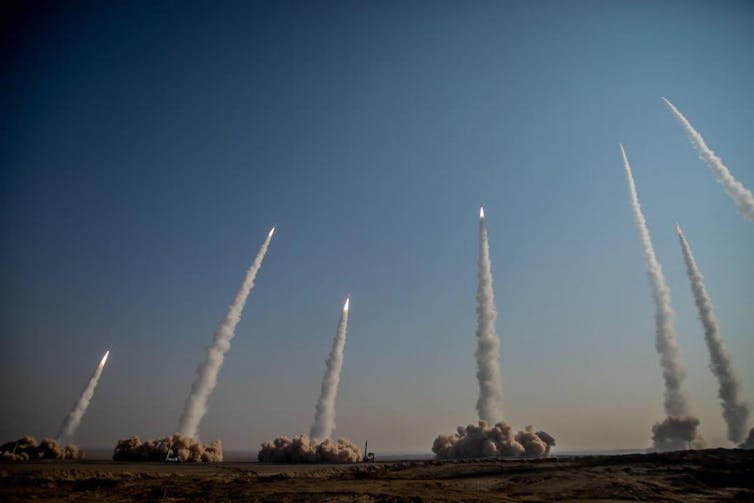
U.S. satellites can rapidly detect ballistic missile launches, like these test launches by Iranian forces in 2021.
Sepahnews/Handout/Anadolu Agency via Getty Images
When a missile is fired, it creates a strong enough heat signal to be seen in space. The satellites detect this heat using sensitive, infrared sensors and send an alert within seconds. This early warning is critical. It gives the military on the ground or at sea time to get defense systems ready.
The warning signal from space is then received on the ground by systems known as the U.S. Space Force’s Joint Tactical Ground Stations. The signal is sent from space using secure satellite communications, received by these ground stations, and then quickly distributed to other parts of the missile defense network.
Radar to detect and track missiles
But satellites cannot do everything to detect and track missiles. They need help from systems on Earth. After a missile is launched, ground-based radars take over from the initial satellite signal. Radars work by sending out radio waves. When those waves hit an object, like a missile, they bounce back. The radar then uses that information to track where the object is and where it is going throughout its flight.
The U.S. uses both short and long-range radars together. One powerful, long-range radar is the AN/FPS-132 Upgraded Early Warning Radar. It can see missiles from over 3,000 miles (4,828 km) away and track them as they travel. Another key system is the U.S. Army’s AN/TPY-2 Surveillance…